Ice, water and power in the Sognefjord
Traveling by car along the shores of Norway’s longest and deepest fjord. Top things to see and do.

Wild, untamed nature can at times be overwhelming and overpowering.
This is exactly what you may experience if you travel to the Sognefjord, Norway’s longest fjord.
For over 200km, from the sea near Bergen all the way to the ice sheet of the Jostedalbreen glacier, the largest in continental Europe, the Sognefjord is like a nonstop beauty pageant, with a succession of dramatic mountain landscapes framing the calm, clean, cold waters of the fjords.
But this area has also its fair share of man-made attractions, both ancient and contemporary…
Sogndal
Located on a peninsula on the north shore of the fjord, this is the county's capital and was to be our base during this trip.
Getting to the Sogndal
We flew into Bergen airport and took a rental car there to drive all the way to Sogndal, all along the road that follows the South side of the fjord.
This is a rather nice 3h drive throughout the Norwegian countryside (it passes through the area where the famous Voss luxury mineral water is sourced).
The shortest route involves a ferry crossing at Laerdal (the alternative would involve a rather long detour through mountain roads)
There is also a small airport at Sogndal, with direct flights to Oslo operated by Norwegian regional airline Wideroe.
A striking feature of the road between Bergen and Laerdal is the amount of tunnels and the length of these. Some of them are tens of miles long and they have conveniently fitted with some colourful vaults that help drivers keep focused on the road. I would not exxagerate if I said that considerable stretches of this route are primarily underground.


It is faster and more convenient to cross the Sognefjord by ferry than drive around it
Sogndal is a rather small town of some 7,000 inhabitants, that in this part of the World can feel like a metropolis. Although pleasant, there is little of interest in the town itself other than it being a services hub for the whole region.
But, very close to Sogndal, the town of Kaupanger has a truly unique gem: a 12th C. stave church.
Stave churches are medieval wooden churches that were once built all over Scandinavia. Although back in their time, they were built in the thousands, today only about 28 of them remain in Norway and a handful more in other locations in Scandinavia and Northern Europe.

Kaupanger stave church, near Sogndal


Where to stay in Sogndal and the Sognefjord

The view of the fjord from the Hofslund Hotel
Hofslund Hotel
Fjørevegen 37, 6856 Sogndal
http://www.en.hofslund-hotel.no
An independent family-run hotel that has been in business since 1912.
It is located right on the shore of the fjord, and it even has its very own pier from where it is possible to plunge into its very cold waters (yes, I tried it myself!).
Traditional style, nice and cozy.

A traditional Norwegian breakfast
Visiting the Nigardsbreen Glacier
An absolute must from Sogndal is a visit to the Nigardsbreen glacier, that it is, in fact, one of the arms of the much larger Jostedalsbreen Glacier.
This amazing wonder of nature is located some 20km up the valley from Sogndal. The foot of the glacier is easily accessible.
There is a visitor’s center a couple of miles from the ice sheet and we could actually get a bit closer than that with the car through a road in good condition.
At the time when we visited there was barely anyone else around (we saw barely half a dozen other people in the immensity of the valley).
Even if you do not get on top of the ice (we did not have special equipment, so stayed just on its edge), the scenery is breathtaking. The solitude of the place adds a lot to the experience (although I don’t know whether this is the case in high season, probably not), just ice, water and rock around.
For more info on how to visit the Nigardsbreen, I recommend checking out this website.


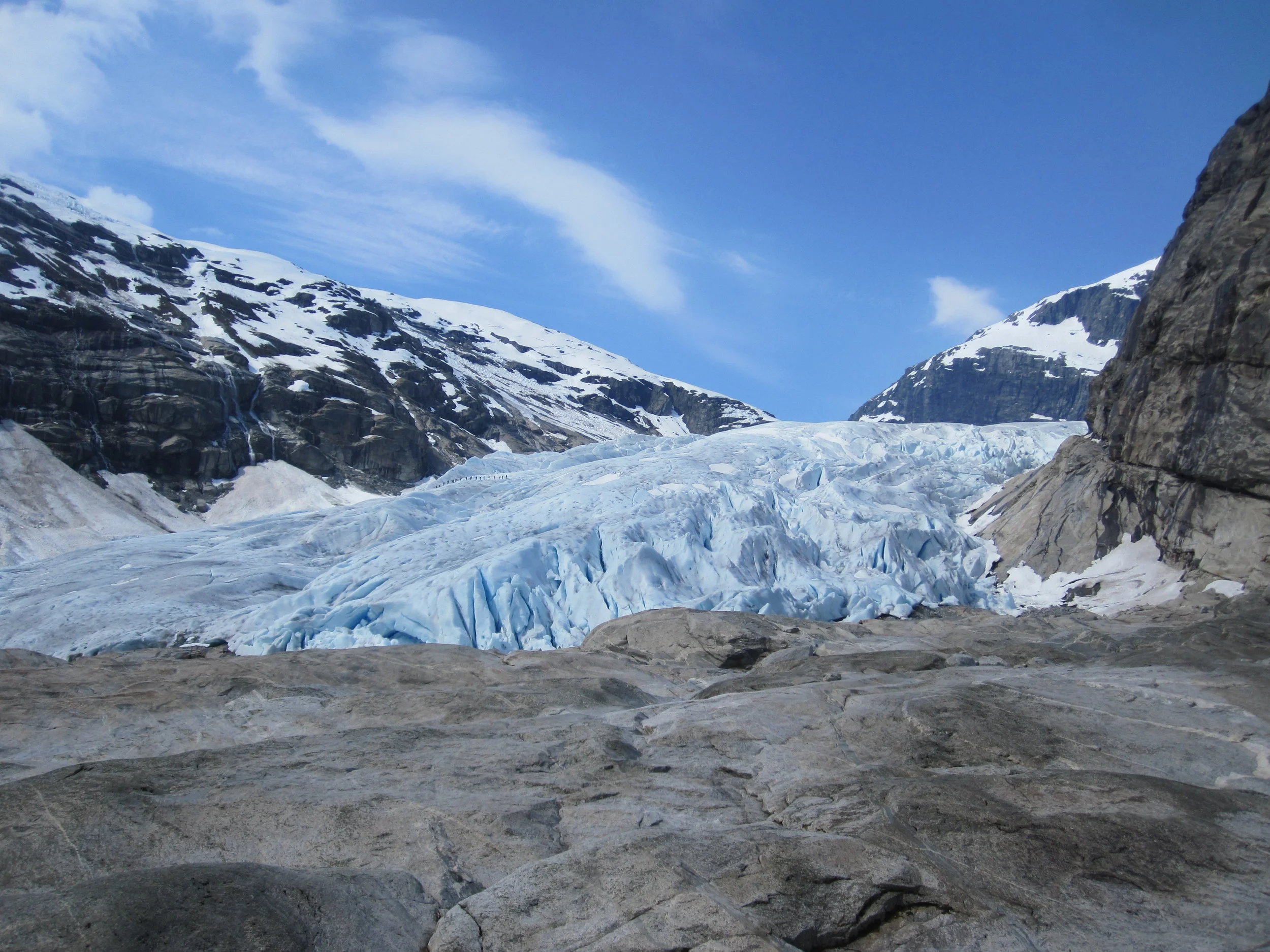
At the time of our visit, you could access the glacier by trekking along the path on the right side of the photograph. It is not a flat and super easy trail, but neither did it require any special training or equipment to get through.

Getting closer to the ice…

And here’s the Nigardsbreen! (you can see the two people at its foot for size reference. In other times, at the right times of the year, local people used the surface of the ice as a sort of highway, to move between the different valleys. Not sure what has been the evolution of the ice since then, or even since the time of my visit, since glaciers seem to be receding pretty much everywhere these days…

This is what the glacier looks like from up close

Jostedal Hydropower Station
As if the wonders above ground were not enough in this part of Norway, there is also a real marvel of engineering underground.
Although an oil-exporting nation, Norway gets most of its domestic energy needs from hydropower. The Jostedal hydro power plant (Jostedal Kraftverk), located on the same valley that leads to the Nigardsbreen glacier and owned by the national electricity company Statkraft, is one of the many that dot the country’s geography, making use of its abundance of water and steep mountains.
I am not sure whether the Jostedal hydropower plant is normally open to the general public, we were able to visit it upon request, as part of the broader work trip that took us to Sogndal, but, as we could see, there are occasional educational tours.


The Jostedal hydro power station has some technical features that make it quite impressive. Rather than being based on a river dam, the turbines are driven by the high pressure water of Lake Styggevatnet.
An underground tunnel channels this water from an elevation of over 1,200m. The pressure is so high when the water reaches the turbines that we were told the concentrated water jet is able to cut through steel.
After having driven the turbines, the water exits the water through another tunnel that takes it to the fjord.
For those interested in learning more about Norwegian hydro power, there is the Norwegian Museum of Hydropower, located in a former hydropower plant in Tyssedal, just South-East of Bergen. I have not visited it myself, but I heard good things about it.
Visiting Aurlandsfjord - Flåm
And now we move already to the South side of the Sognefjord. The two branches of the Sognefjord known as the Aurlandsfjord and the Nærøyfjord have UNESCO World Heritage Status and are some of the most visited spots in the region.
In this area, the tiny hamlet of Flåm stands out.
Flåm is located at the head of the Aurlandsfjord, one of the Southern branches of the Sognefjord. Two factors contribute to it being one of the most touristy spots on the Sognefjord: it is a docking spot for cruise ships and it is a stop on the Bergen to Oslo railway line.
Otherwise, and although certainly beautiful, I did not find the Aurlandsfjord to be particularly more attractive than other corners of the Sognefjord region.
Besides a walk through the village, I would recommend (if you have a car), to drive to the Stegastein (Bjørgavegen 83, 5745 Aurland) viewpoint, on the fjord’s Eastern flank.
Here’s a modernly designed viewing platform that protrudes from the side of the mountain.

Flåm is regularly visited by large cruise ships

The entrenchment of water into the mountain landscape produces images like this in this part of Norway

Some earlier forms of ship-borne visitors

Aurlandsfjord from a vantage point
Lærdal - Visiting the Norwegian Wild Salmon Center
If salmon is one of Norway’s top exports, the Sognefjord is (or at least, used to be!) a particularly rich breeding ground for the species.
Also on its Southern shore, the town of Laerdal is home to the Norwegian Wild Salmon Center.
Norsk Villakssenter
Øyraplassen 14, 6887 Lærdal
http://www.norsk-villakssenter.no/en
This is a modern museum and interpretation center about the life cycle of salmon and its fisheries. The center has even some aquariums, fed by the running water of the village’s stream, where you can see live salmon in their habitat.
Besides that, the village of Laerdal has a small, but very neat center, with streets lined with colourful houses that make for a rather pleasant stroll.

There are quite a few more things to do and to see in Sognefjord, from tasting the famous Undredal brown cheese to a broad range of outdoors activities, but this was actually a rather short trip.
Wouldn’t like to close this story without a couple more pics of the top attraction of the Sognefjord, though, the amazing Norwegian landscape!


Behind the scenes at the Cirque du Soleil
One of Québec’s most popular exports, alongside aircraft and “poutine”, is the magic of the Cirque du Soleil…

It was a wintry morning when we visited the Cirque du Soleil’s HQ. Here the view from the conference room, with downtown Montréal and the hill that gives its name to the city (to the right)
One of Québec’s most popular exports, alongside Bombardier aircraft and the famous, highly-caloric dish “poutine”, is the magic of the Cirque du Soleil.
What started as a mere band of street jugglers has become, in a matter of decades, a global entertainment business with several simultaneous shows running all over the World.
The Cirque du Soleil, however, remains firmly rooted in the city of Montréal, where it has its HQ.
After having been able to enjoy, a few months ago, “Sonor”, one of the Cirque’s latest shows, onboard the cruise ship MSC Meraviglia, I accepted an invitation by MSC Cruises to come to Montréal and see the backstage where these shows are conceived and readied for launch.
During this trip, I not only had the chance to learn about this very unique company that is the Cirque du Soleil, and get acquainted with the modus operandi that lies at the base of its success, but also, and despite the cold December weather, to explore on foot some of the most interesting bits of Québec’s largest city.
A city of creativity


The Cirque du Soleil HQ is located in one of Montreal’s northern suburbs.
It is a rather special place, that combines the cold, modern functionality of a corporate headquarters with the vibe of a creative environment, the healthy discipline of a high performance sports training center and the buzz of an artisan workshop.
Because the Cirque du Soleil is all of these things at the same time.

One of the open areas at Cirque du Soleil HQ
To give you an idea of the orders of magnitude we are talking about, some 4,000 people work for the Cirque du Soleil globally, and of these around 1,500 are based in Montréal.
But, how does the Cirque find the rather exceptional artistic talent that is needed to staff all those shows?
Well, it sources it from, literally, everywhere.
It has what is, arguably, the largest professional database in this segment, with over 55,000 artists. So, the Cirque’s recruiters are quite sure to find whatever skill they need, whether it’s former gymnasts or whole families of acrobats (something not unusual in some parts of the World).
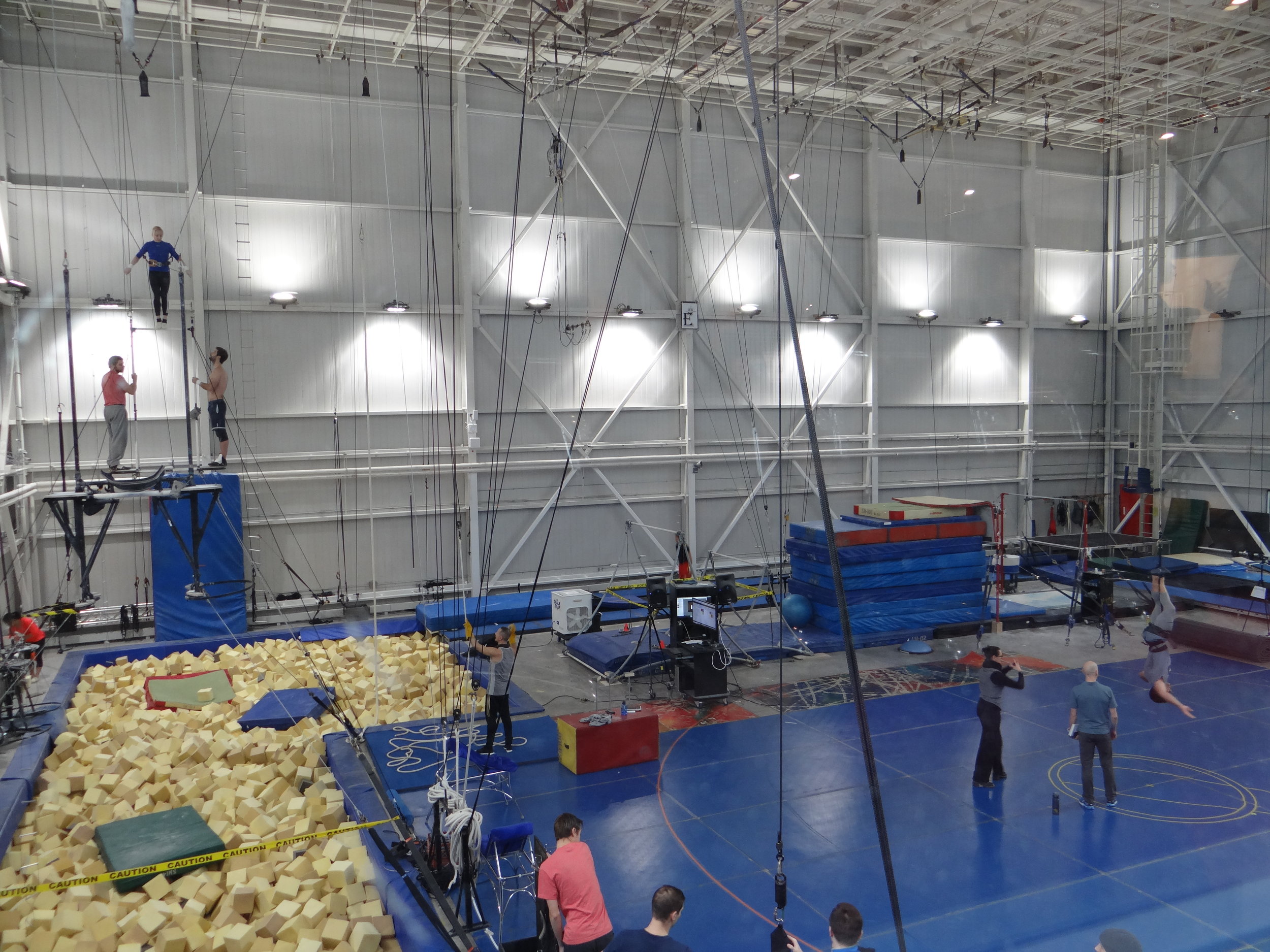
Whenever there is a new show in the making, the selected performers gather in Montréal and practice together for a few months at the Cirque’s facilities. We had a chance to observe some of them in action, training and it was hard to keep the attention at any one place, since there was so much going on at the same time at the large, factory-sized training facility.

The Cirque du Soleil at Sea
If its performances are usually an artistic tour-de-force, the Cirque du Soleil has taken things one step further by developing a new generation of shows specifically designed to fit in the constrained spaces of cruise ships.
The partnership with cruise operator MSC Cruises has produced already four of such shows, “Sonor” and “Viaggio” on MSC Meraviglia and “Varélia” and Syma” on the recently launched (it had its maiden voyage on 4th March) MSC Bellissima. Four additional shows are being prepared for the upcoming new ships MSC Grandiosa and MSC Virtuosa, that will be launched in late 2019 and 2020 respectively.
Syma is the story of a young sailor that is stranded on an island full of fantastic and mysterious creatures.
Varélia is about a princess with violet skin and its admirer-hero, who happens to be blind. Then there is a villain, that kidnaps the princess because he has an obsession for all things violet. The hero will embark on a quest to liberate her, with the help of some other friendly characters…
At the time of this visit, the Cirque and MSC were readying the launch of these two shows.
Thus, we were shown a preview under conditions of strict confidentiality and learned about the challenges of performing on a moving ship.

The creative team explains the concept behind the show “Varélia”, that launched on MSC Bellissima in March 2019
The shows themselves are of a smaller, shorter format than the ones on land.
There are several factor that need to be taken into account, one is the fact that the ship is not static. In the evening, when the performances take place, the ship is usually moving and, although we are talking about some of the largest ships in the World, some swell is inevitable.
Another factor has to do with space, as it is obviously at a premium onboard a ship. For this venture, MSC built dedicated theatres at the stern of the ships. These have a special, custom-made design at a cost of over $20M each.
Last but not least, the logistics are also constrained. If a show on land can typically employ some 50 performes and another 170 as support crew, the sea-going troupes are usually 15-16, with a similar number as support staff.

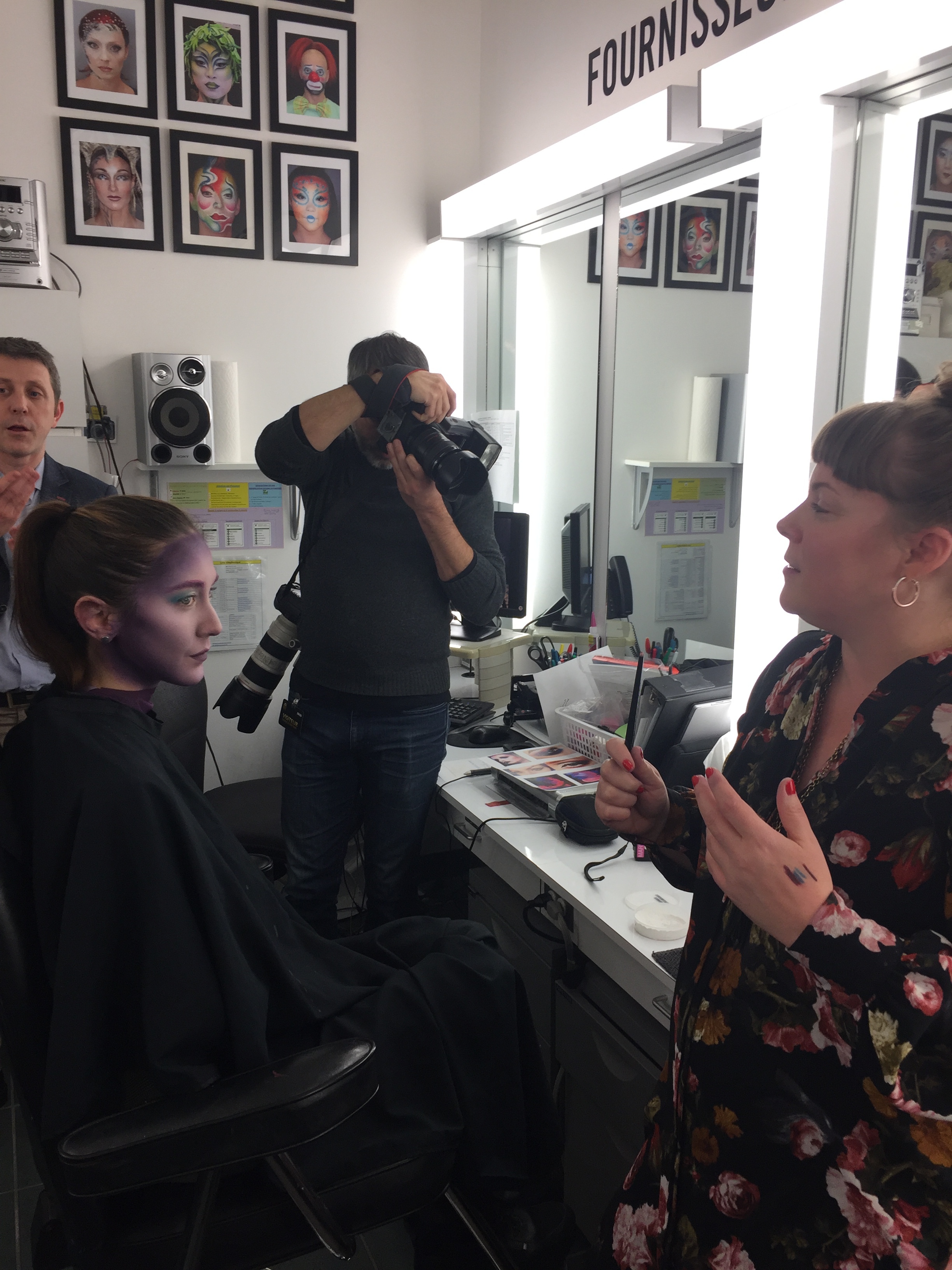
While they are at sea, the artists have to rely on themselves, this includes make up. Here they train them, so that they are able to apply their own make up before the shows as well.
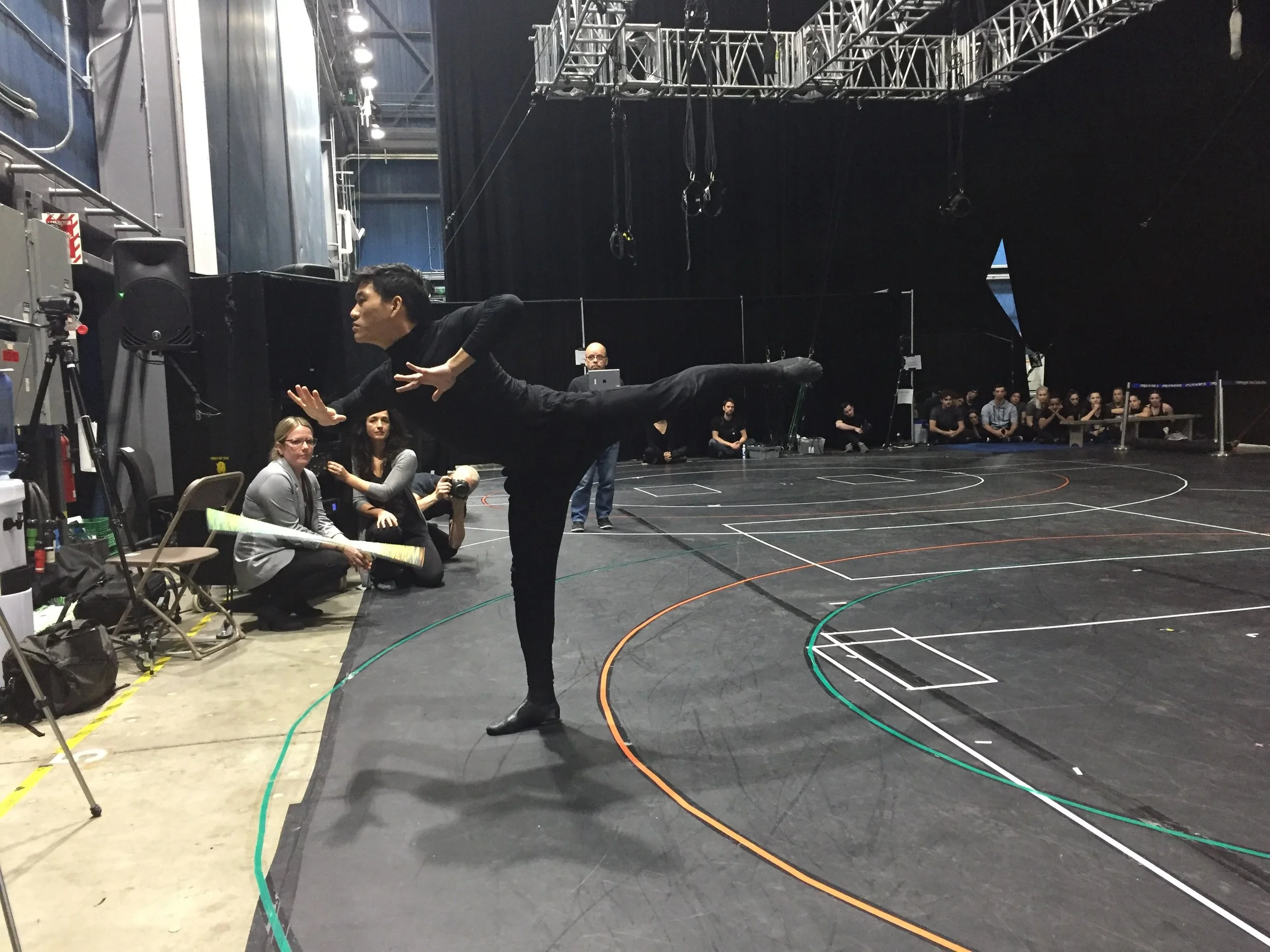
Another highlight of the tour was a pre-view of different scenes of the two new shows designed for MSC Bellissima. These are now, more or less in the open, but not at the time of the visit. One of the things that truly amazed me is the effortless look of those practicing these amazing stunts. I am sure there is a lot of work behind them, but, the appearance of ease and naturality is simply awesome.


The Workshop
The show’s are expected to be visually stunning, this is one of the hallmarks of the Cirque.
One of the essential functions of the Montréal HQ is to act as a supply center for all the Cirque’s branches around the World, whether in Las Vegas, China or a cruise ship somewhere in the Mediterranean.
in addition to its administrative and training functions, a third and rather large section of the Cirque’s facilities is occupied by a super-sized workshop. Here all sort of costumes and atrezzo are designed and manufactured to match the demands of each of the shows.
Everything is done in-house and even the clothes and shoes are made to measure.


Technology plays a role in Cirque’s du Soleil shows, of course, but it is very subtle, a support rather than the main theme. The artists remain the protagonists at all times.
And this is also true behind the scenes. A large amount of processes and work is done by hand. It’s artisan work. But different technologies are also leveraged, for example a broad range of innovative materials are used for lightness and comfort, even if sometimes are made to look like another sort of material. It is a constant process of experimentation, that gets feedback from the performers all the time.
Also, 3D printing (below), for example, is finding its uses in this environment that requires a high degree of customization.

The result of all this…you will need to book a cruise on either MSC Meraviglia or Bellissima to find out!
BONUS: A walk through Montréal
It was a short trip, but there was also some time to visit Montréal’s downtown and its historial center, one of the oldest and in North America, and allegedly one of the most charming too…although it was rather cold and deserted at the time of my walk!
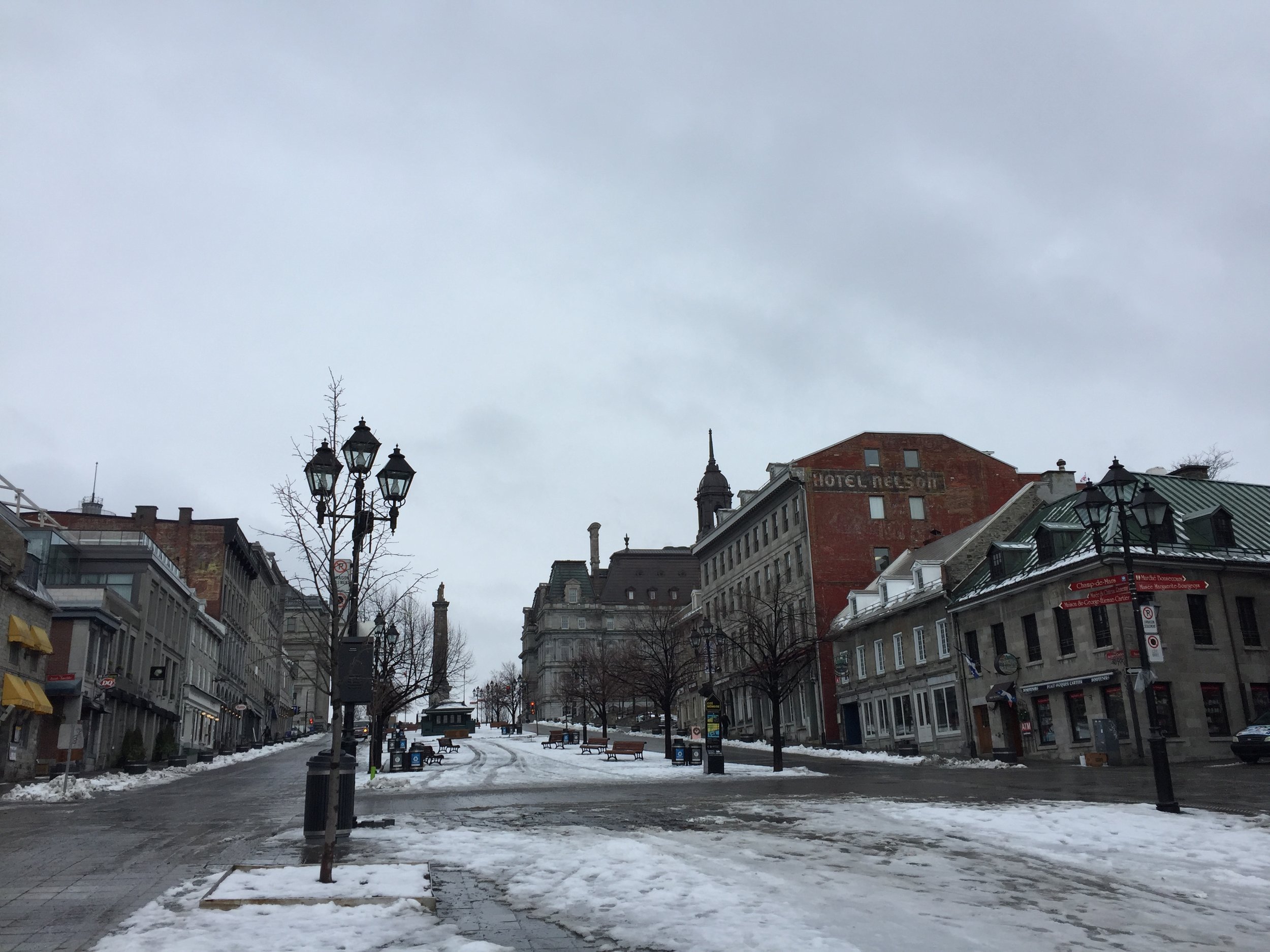
Place Jacques Cartier, with the Nelson column at the end of it
Montréal is built on an island on the St. Lawrence river and the old town, the Vieux-Port area, occupies its Eastern shore. The stone houses and 18 and 19th C. architecture gives to this district a rather harmonious, “old-world” vibe, although the historical area, properly speaking is quite small, at least for European standards.
One of the details I found interesting is that of these two statues below, located on the Places des Armes, the historical heart of the old city. They, apparently represent the British (him) and French (her) powers, the tension between the two cultural and political spheres that have shaped the history of Montréal and the rest of Québec.


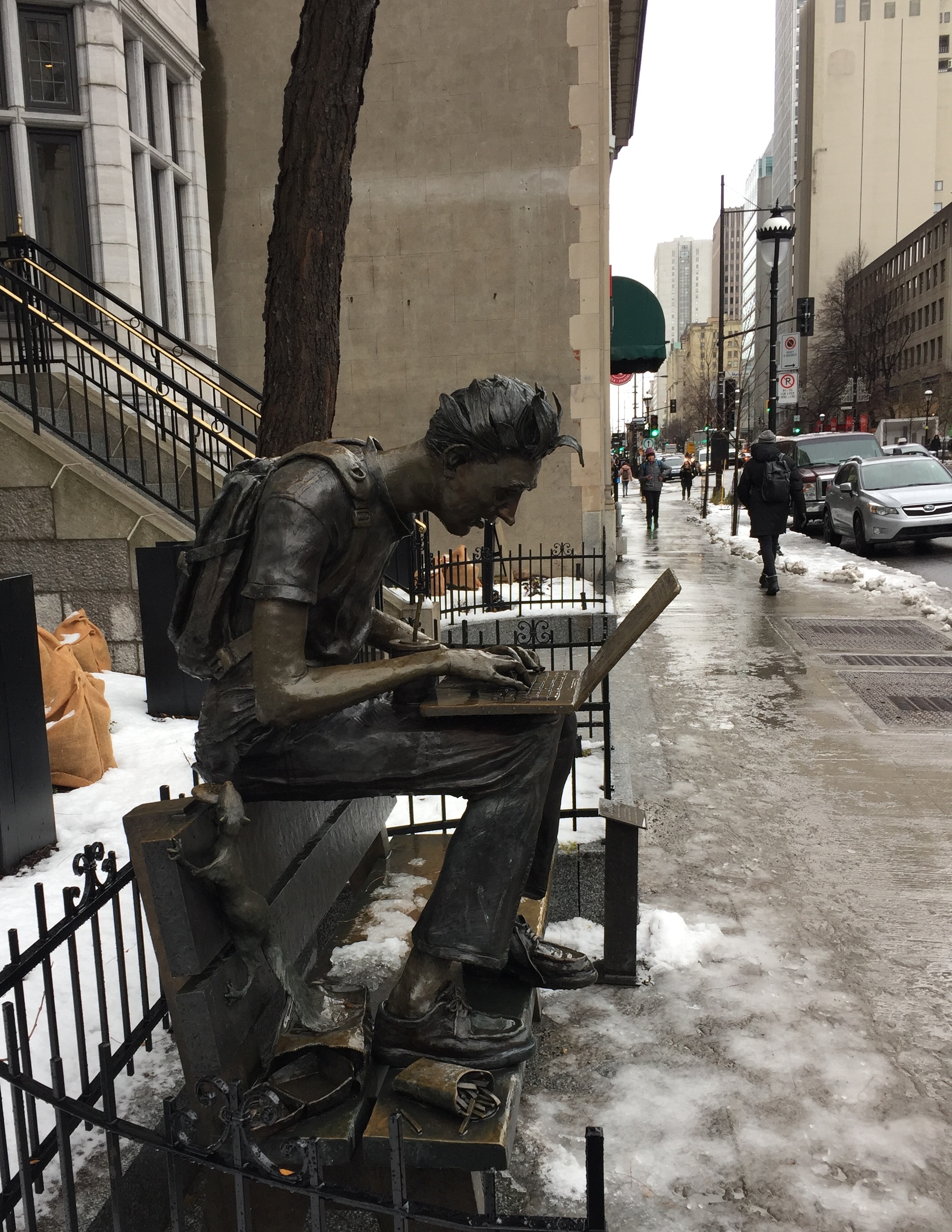
Moving away from the Vieux Port and into the modern downtown, I found this other statue, perhaps with less political undertones, but undoubtedly very representative of the times we live in.

A view of downtown Montréal from the snowed-in campus of McGill University
Where to stay in Montréal
The Fairmont Queen Elizabeth
900 René-Lévesque Blvd W
Montreal, QC H3B 4A5
The embodiment of a landmark hotel.
A big, granitic, building in the very center of the city. It is even possible to access the metro directly from its premises.
Nice views from the upper floors. Rooms with a contemporary, warm design and large bathroom.


One of the pluses of this hotel is the executive lounge on the top floor.
Here there is a cozy atmosphere and it is possible to enjoy either breakfast or a selection of tasty snacks, sushi, cold cuts and drinks during the day.

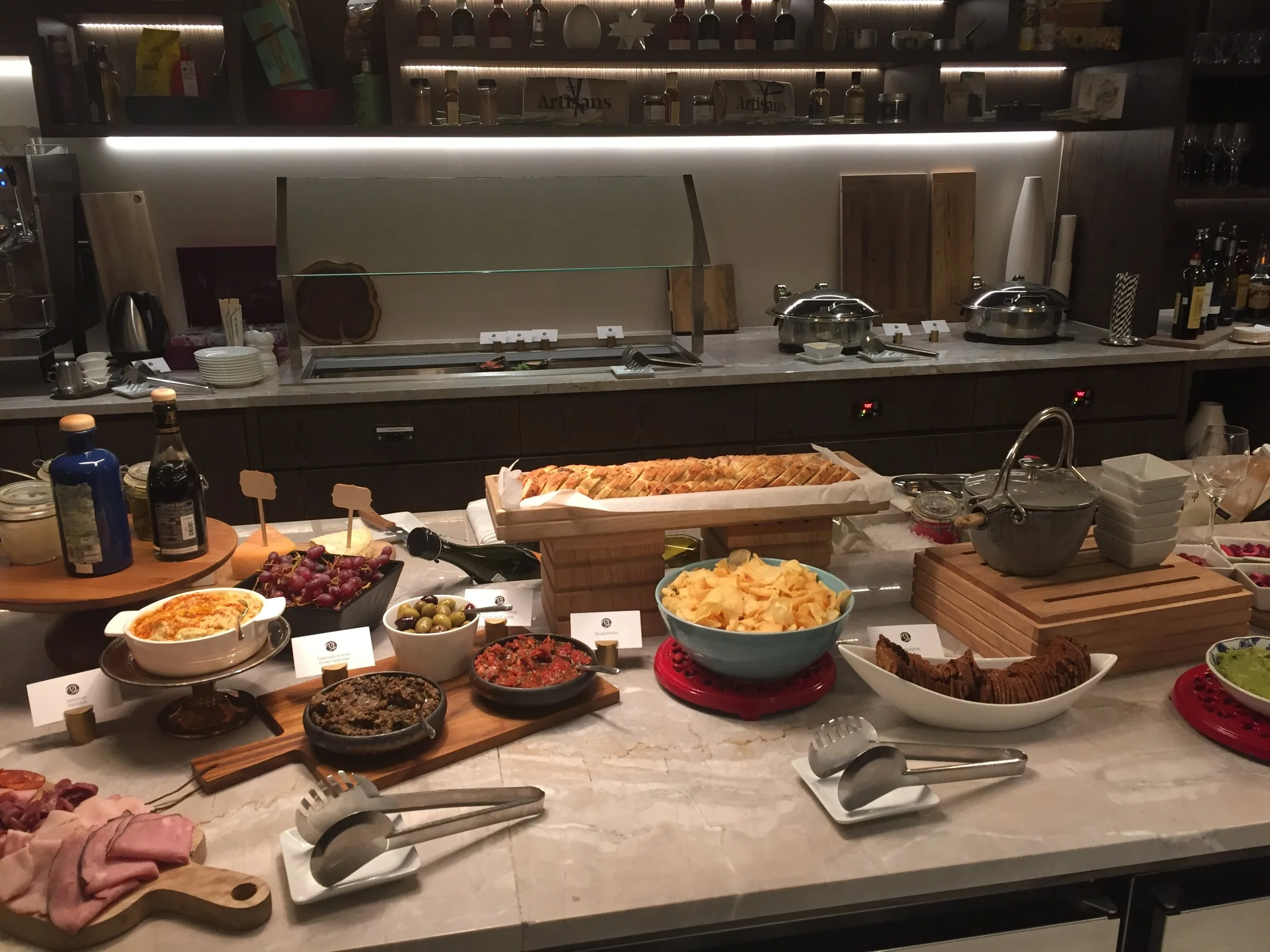
…and did I tell you that the views are also great?

The view from the executive lounge at the Fairmont Queen Elizabeth
Places to eat in Montréal
La Champagnerie
Tasty food and nice, joyful atmosphere
343 St Paul St E, Montreal, QC H2Y 1H3
https://www.lachampagnerie.ca

Aside from the food, La Champagnerie has some other pluses:
Its location on one of the most picturesque streets of Montréal’s old town and the cozy atmosphere inside (the two go well together)

As a curiosity, it seems that one of the traditions of the place is that they show guests how to uncork a bottle of champagne with a sabre!

The main dish at La Champagnerie. Apologies: no notes on what it was!
Ristorante Beatrice
Upmarket Italian food
1504 Sherbrooke St W
Montreal, QC H3G 1L3
http://beatriceristorante.com
Le Balsam Inn
International food - young atmosphere
1237 Metcalfe St, Montreal, QC H3B 2V5
http://lebalsaminn.com

Here is the Farro aux Champignons Sauvages

Faded Genoa and its hidden gems
It is undeniable the city of Genoa has seen better times, yet, some pleasant surprises await…

The famous “lanterna”, an old lighthouse that has traditionally signalled the entrance to the port of Genoa. It has become part of the popular imaginary in such a way that, in Italy people say “I am under the lanterna” (“sotto la lanterna”) as a synonim of “I am in Genoa”
Once the capital of a mighty maritime empire, it is undeniable the city of Genoa has seen better times.
Unlike Venice, Genoa has managed to preserve its role as a maritime-industrial city, yet it lacks the iconic status of its historical arch-rival. Not only that, but its many charms are often overlooked by tourists that see it just as a gateway to Portofino and the Italian Riviera or, simply, as a port of embarkation for the many cruise ships that have it as a port base.
To be fair, having passed briefly through the city once in the past, this is an opinion I shared to some degree…until I recently had the chance to spend a full day in Genoa exploring it throughout.
In this post I am going to try to illustrate why I think Genoa is quite an underrated city and why you should consider adding it to your Italian bucket list…
In fact, this chronicle is quite limited in its scope: what to do, what to see and what to eat in the historial center of Genoa in one day.
There are quite a few more things to do in Genoa, such as the whole maritime promenade (with its Aquarium and museum) as well as the modern part of the city that are not covered here, but may be worth considering if you are planning to spend a longer time in the city.
The Port and Historical Genoa
As one of Italy’s historical four “Maritime Republics”, Genoa’s life has for centuries revolved around its port and the old city occupies a hill just above the port basin. In fact, the whole territory in and around Genoa is quite hilly and flat space is at a premium!

This is a photo from a previous visit to Genoa, when the weather was a bit better!
A practical way to see the city is to take the Piazza De Ferrari as a starting point of your itinerary. This square, that serves a nexus between the old and new parts of the city, is not only is well communicated by metro (yes, there is a metro in Genoa, although it has only two rather short lines), but from its elevated position at the hilltop it is easy to reach any other point of the historical center on foot.

The walls of Old Genoa
Leaving aside the port, I would say Genoa does not have one single major attraction that outshines all the others. What makes it quite interesting and unique is the ensemble of its historical center: a maze of narrow streets and alleys, peppered with remains of its glorious past, such as the avenue of the palaces (that we will review later in this post). So get a good pair of boots, have a nice breakfast and prepare to walk…
One possible itinerary to optimize your time while getting a good general view of the city is to go down Via San Lorenzo, from the cathedral towards the port, then, turn right towards Porta dei Vacca. You may want to go all the way to the Palazzo Reale (that hosts a museum), before turning back again towards the old town and Via Garibaldi to visit its magnificent palaces.

Like in any other European city of note, the cathedral is one of the focal points of the old town.
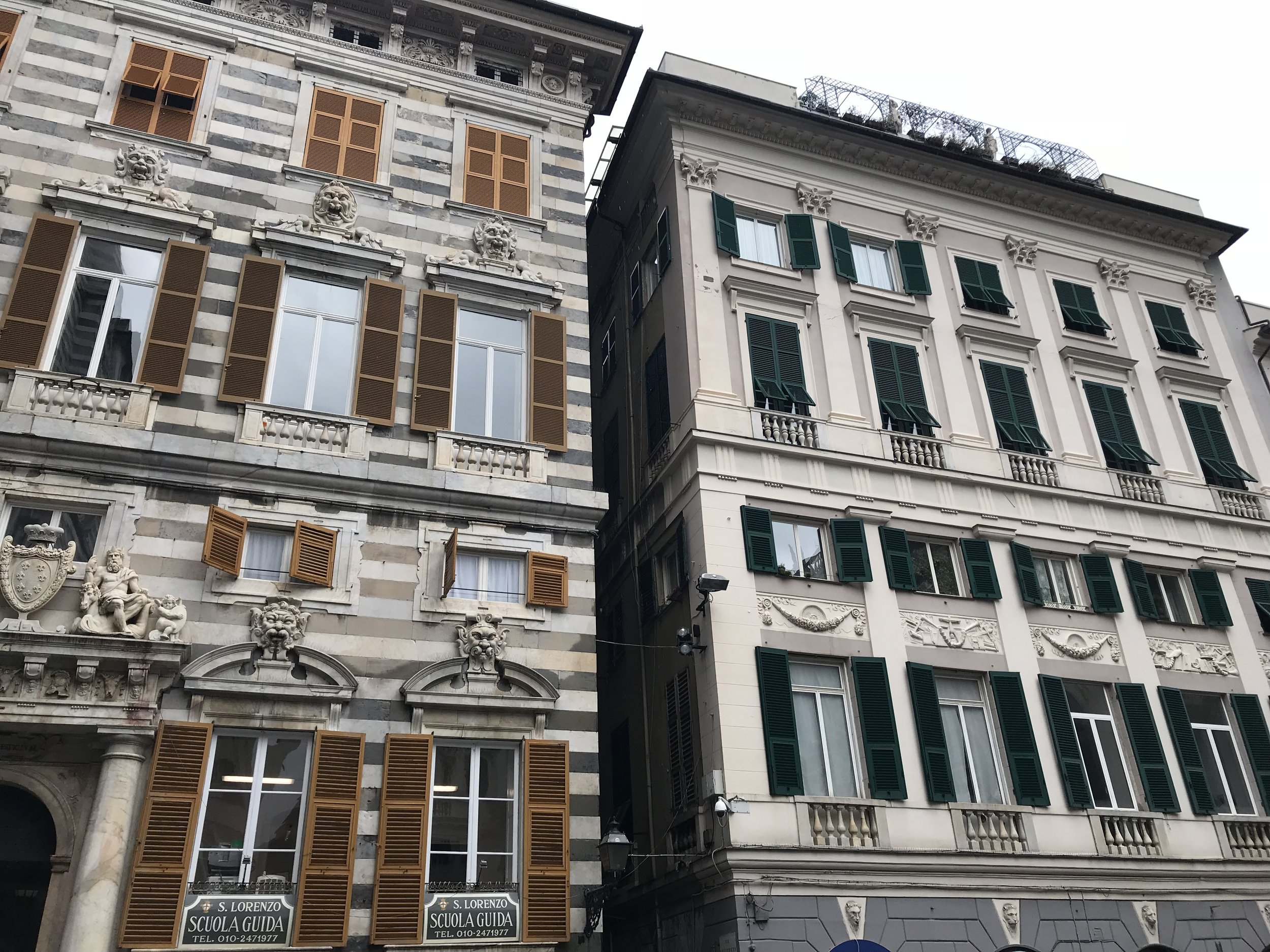
The architecture on Via San Lorenzo
Although there are quite a few attractions around the port, such as the Aquarium, it is a pity that Genoa’s seafront is not (yet) very pedestrian-friendly. Unlike in other Mediterranean cities that have implemented urban reforms to modernize and open up their maritime façade, here there is still quite a lot of industrial activity going on and there are motorways between the quays and the city. Plus most of the buildings, shops and restaurants facing the port are in a rather decadent state.
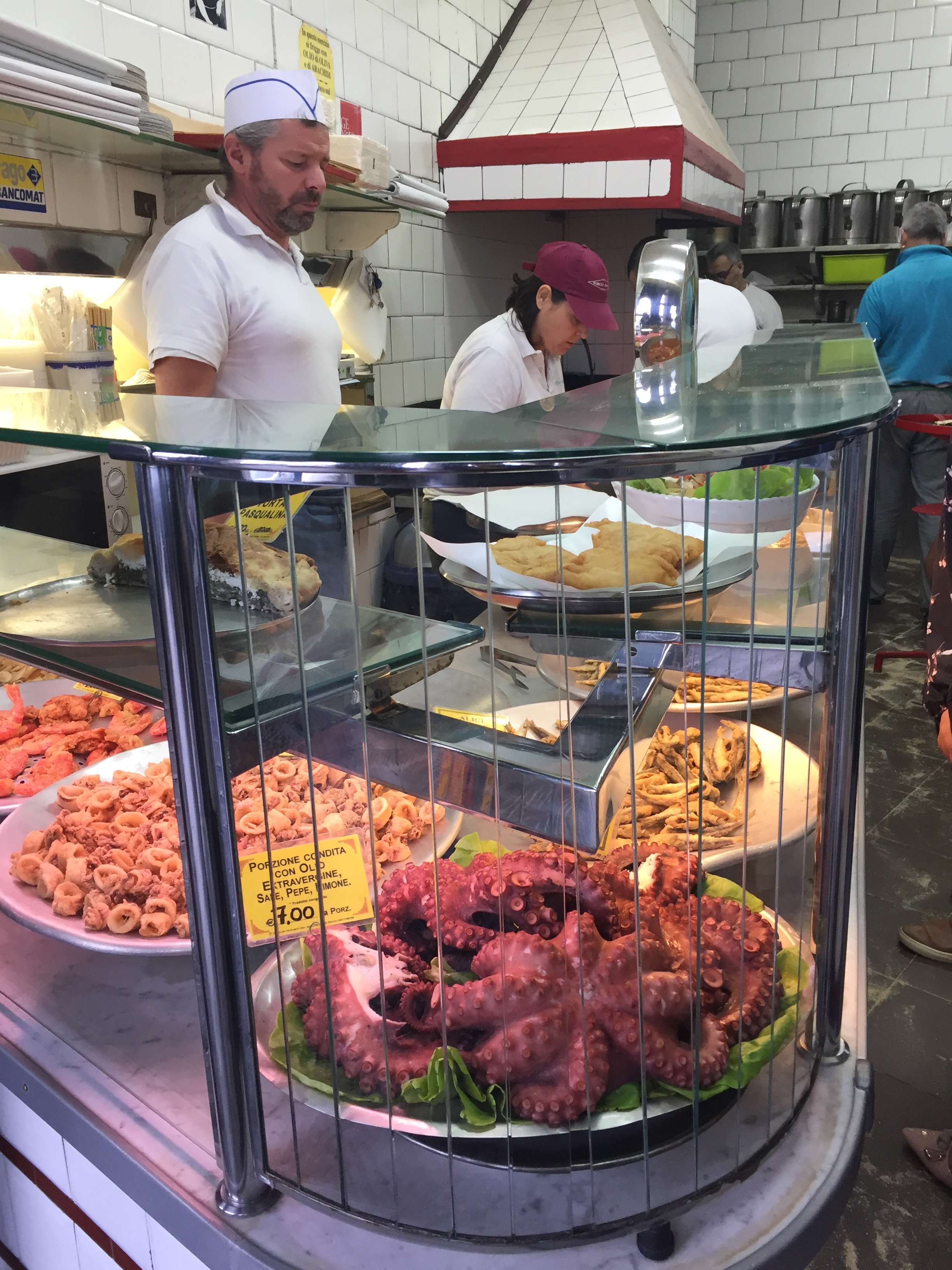
All along the port it is possible to eat at these small, popular restaurants specializing in seafood. Fast-food Genoese style. We would go back to food later, but in a rather different way…

A typical street in Genoa’s historical center, you can spend the whole day walking around these
Genoa played its role in the Italian Risorgimento and the unification of Italy, in mid-19th Century. Walking around the city you may stumble upon some plates that recall that era.

Mameli, the composer of Italy’s national anthem, lived in Genoa, close to the cathedral.
Another plate, near the port, remembers another key episode of the wars of Italian unification: Garibaldi’s expedition of the Mille, that assembled in Genoa before sailing to take Sicily.

Places to eat in Genoa
Antica Sa Pesta
Via dei Giustiniani, 16/R, 16123 Genoa
https://www.sapesta.it
The place to go to taste local Genoese and Ligurian cuisine, particularly the local speciality “farinata”. Thankful to the local that suggested it to us!
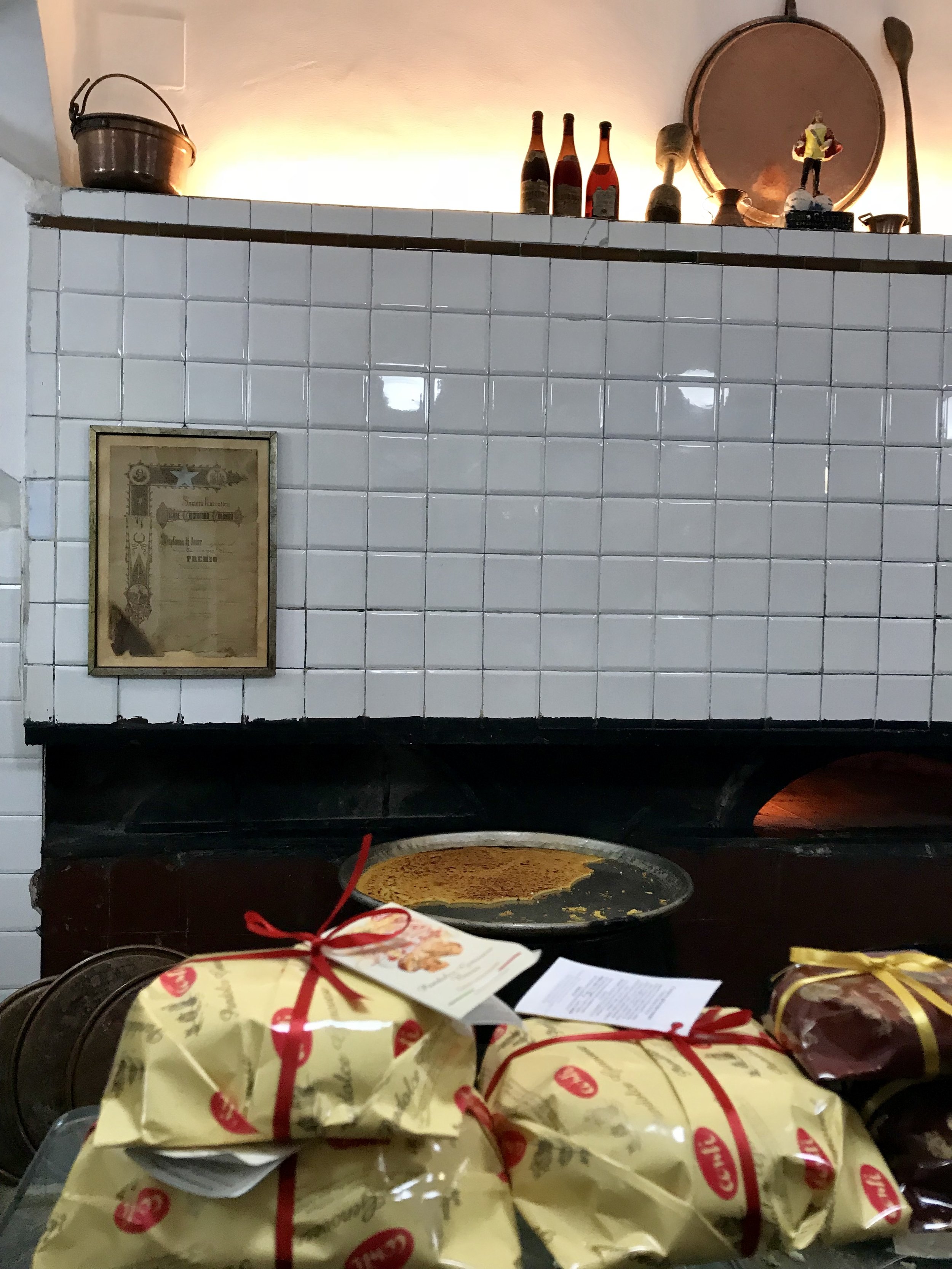

“Farinata” is the perhaps the most typical dish of Genoa. It is a sort of pancake made of unleavened chickpea flour, that is baked in the oven.
The one prepared at the restaurant Antica Sa Pesta was excellent and really great value. It’s their speciality.


Classical “farinata” on the left, nothing but baked chickpea flour. On the right, “farinata” stuffed with cheese. Both tasting great.

We also tasted this delicious seafood pasta

Ready to continue the walking tour after a well deserved pit-stop

Definitely not flashy and without pretensions, a proper hidden gem. (Avoid the touristy restaurants that abound on Genoa’s main thoroughfares…!)
The restaurant Sà Pesta is a rather small, modest-looking affair, but the atmosphere oozes authenticity. Would repeat without a doubt next time I am in Genoa.
The Palaces
As an old, rich, trading republic, Genoa has its fair number of palaces, built by the local oligarchy as a display and reflection of status and success.
Luckily for the tourist with limited time, three of the most impressive palaces are currently in public hands, and are located literally next to each other on the same street, Via Garibaldi.
They are the Palazzo Rosso (Red Palace), the Palazzo Bianco (White Palace) and Palazzo Tursi.
In addition to their interiors, which have an historical interest in themselves, the Palazzo Rosso and Palazzo Bianco host also notable art collections.
The ensemble of these palaces is known as the palaces of the “strade nuove” (“new streets”) or “palazzi dei rolli”, most of which were built in the 16th and 17th century at a time of urban expansion in Genoa (hence the “new streets” name).
42 of 163 palaces (yes, Genoa is really a city of palaces!) have been granted World Heritage status by UNESCO, among them, the three commented here.
It is possible to buy a combined ticket for the three (recommended)

Palazzo Rosso
This is perhaps the most interesting of the three (IMHO)
It belonged for centuries to one of the most prominent Genoese families, the Brignole-Sale, who happened to be also avid art collectors, hence the origin of the collection currently on display at the Palazzo Rosso.
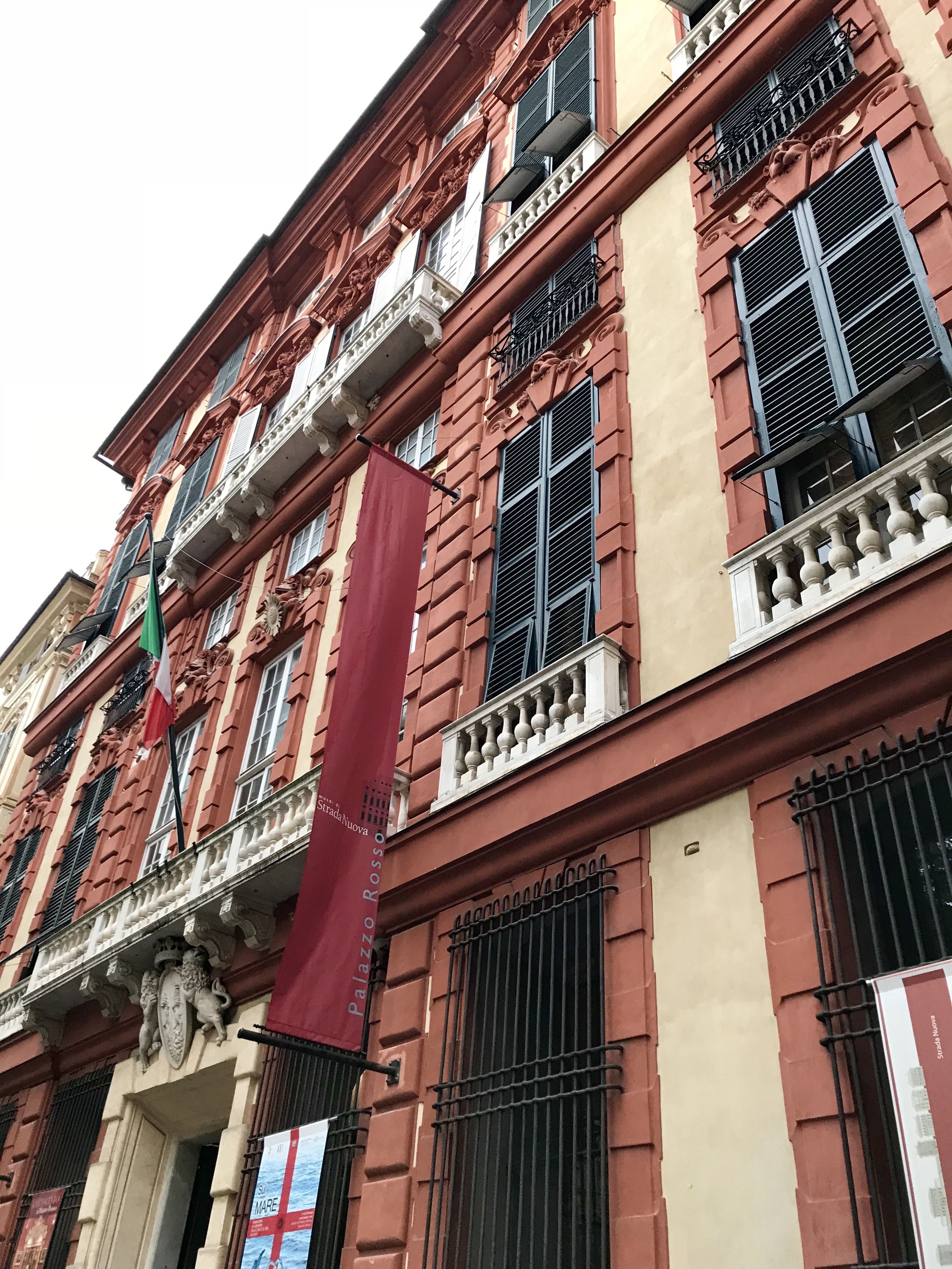

The Palazzo Rosso has several floors, where it is possible not only to admire its valuable art collection, but also to see some of the apartments where the palace owners lived at different periods in time.


The view from the upper floors of the Palazzo Rosso
Although I liked the Palazzo Rosso the most, and despite the risk of serious artistic overload, I did not want to close this section with a couple more pictures of the art that seems to be everywhere in Genoa


A visit to the market
Mercato Orientale
Via XX Settembre, 75r, 16121 Genoa
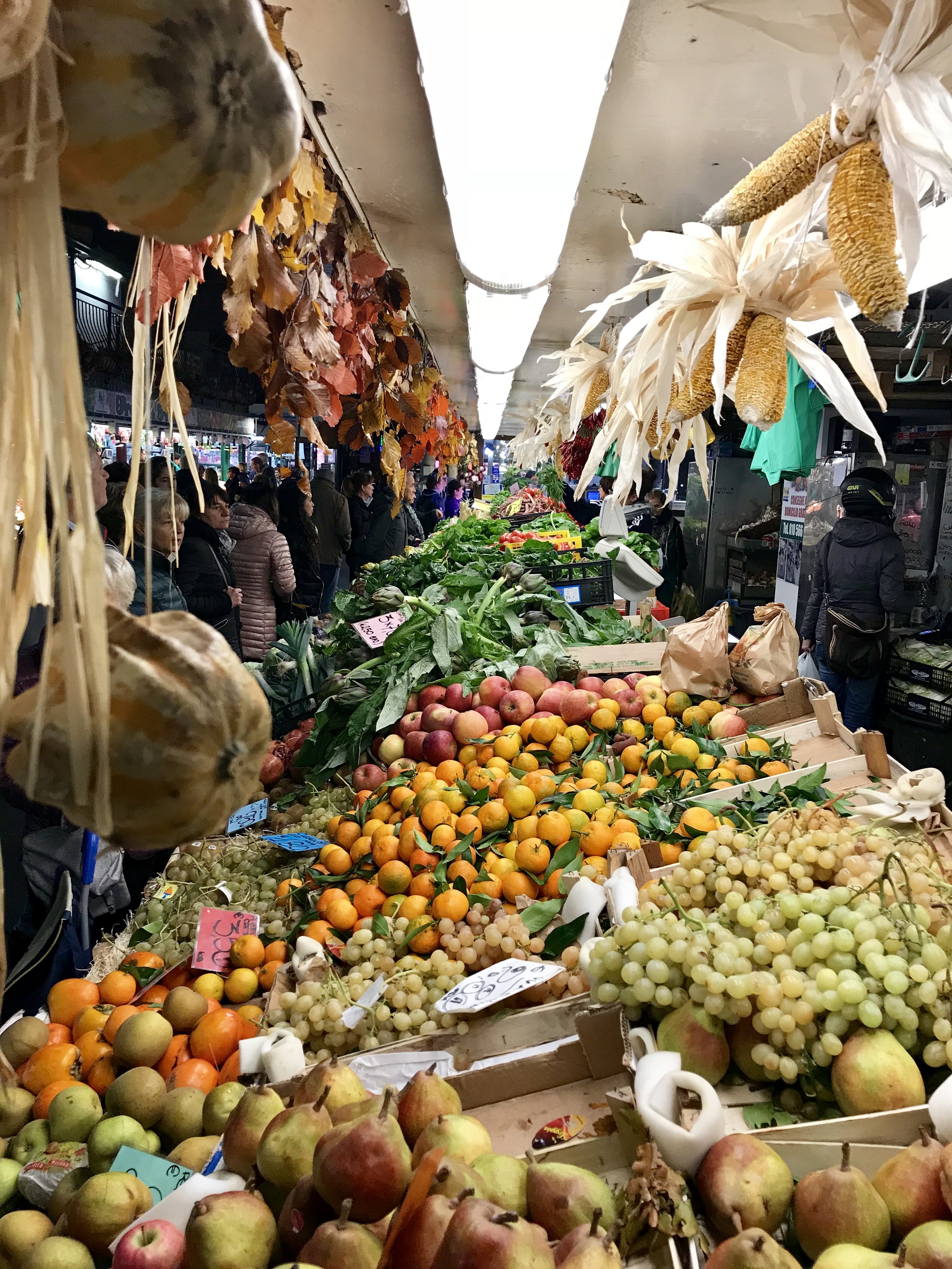
If you like the exuberance of a fresh food market, don’t leave Genoa without stopping at the Mercato Orientale.
Located in what used to be the cloister of a former church, this market is a wonderful festival of colours and smells, as fresh produce from all over Italy piles up at the stalls.


Places to eat in Genoa
Da Leccarsi i Baffi
Piazza Cavour, 91r, 16128 Genova, 16123 Genoa
A place to continue with the exploration of Ligurian cuisine, particularly of seafood.
At this modern and cozy restaurant you will be able to taste, for example, sardines prepared according to the local Genoese recipe.

There is also a diversity of seafood dishes, like this pasta (below), which was truly delicious.
Service was great as well, and, with most of the people eating there being locals, it definitely does not feel like the many tourist traps that line the streets a bit further up the center.
Recommended.

Night walk in Genoa
And to wrap up this intense day in Genoa, a couple of pics to illustrate the night walk to the hotel.

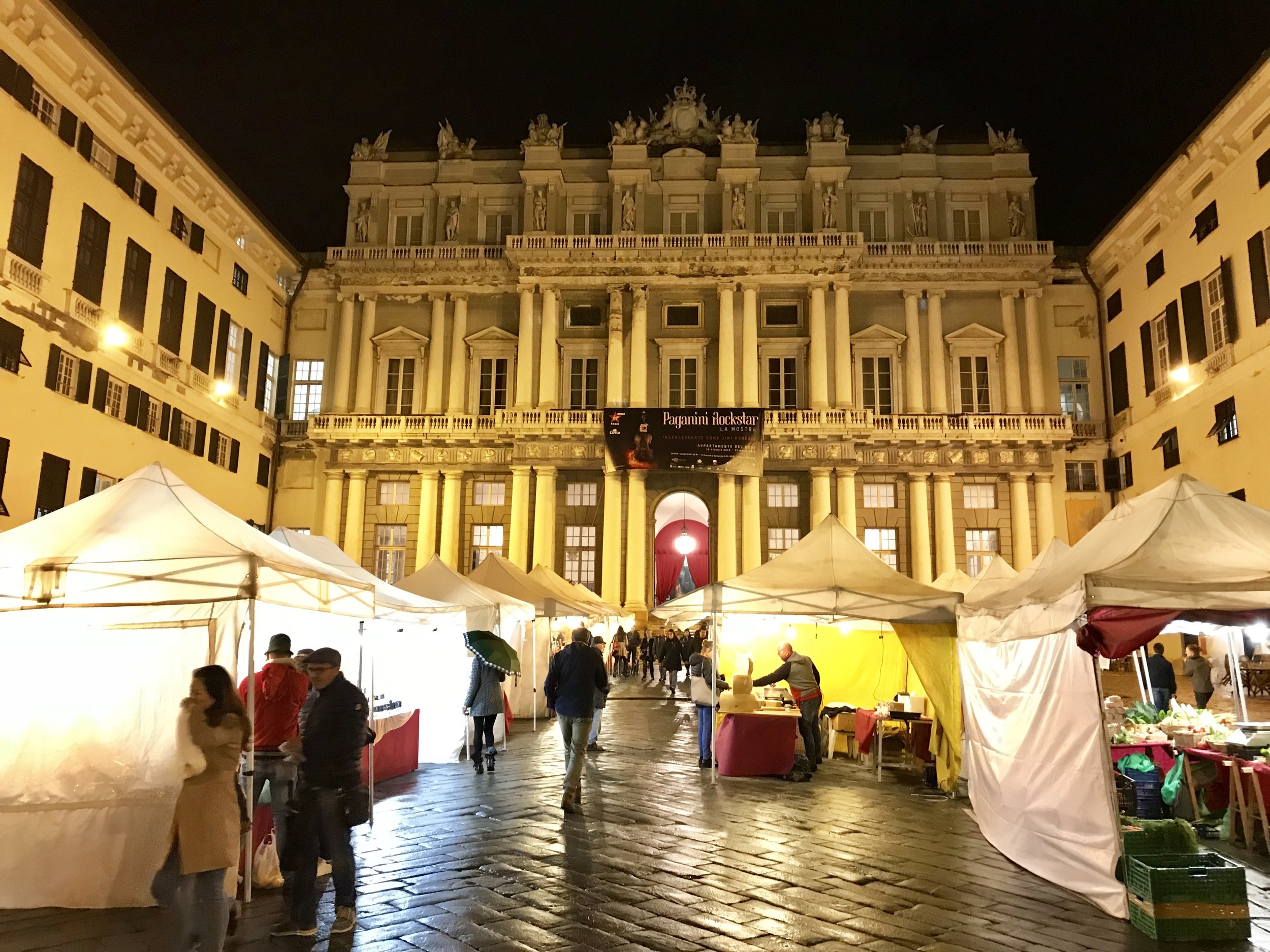
A street market in the courtyard of the Palazzo Ducale
Hotels in Genoa
Holiday Inn Genoa City
Via Milano, 47, 16126 Genova
It is business-style four star hotel. A bit impersonal, I know, but it turn out to be very modern and have huge rooms (almost like a little apartment, not sure all the rooms are the same, though).
It is not in the very center, although the distance is walkable. There is also a metro station within 5 minutes walk (convenient since it was raining!) and the trains take you to De Ferrari station in the very center in less than 10 minutes.
It is a very convenient option if your are embarking or disembarking from a cruise ship, as it is located right next to the maritime terminal (the hotel was, in fact, booked by the cruise company that arranged the rest of our trip)
Winter fairytale in Suzdal
Russia’s Golden Ring has become a bit of a tourist brand in recent times, yet the number of tourists that make their way to this string of historical towns…

Russia’s Golden Ring has become a bit of a tourist brand in recent times, yet the number of tourists that make their way to this string of historical towns located within driving distance of Moscow is still relatively small for European standards.
Here you will find some of Russia’s oldest towns, complete with their own kremlins (a word that, despite its more recent geopolitical meaning, denotes actually a “fortress”) and ancient churches with their traditional onion-shaped domes.
Perhaps one of the easiest and most interesting Golden Ring towns to get to, and one whose dimensions make it perfect for a weekend away from the buzz of the Russian capital, is the charming old city of Suzdal.
How to get to Suzdal
Suzdal is some 200km East of Moscow, or some 4 hours by car (and option I would not recommend unless you are used to driving on the Russian roads)
The train provides a faster and more convenient option, in my opinion.
We travelled from Moscow to Vladimir on a fast train called “Lastochka” (Falcon) and for the last 15km between Vladimir and Suzdal (the town is not linked to the railway network) we took a local taxi. As Vladimir is on the main trunk line to Nizhny Novgorod (and beyond), train service is quite frequent. The Lastochka trains are modern and comfortable, on a par with fast intercity in most Western European countries.
The ride between Moscow and Vladimir takes about 1h 45min and costs about between 1,400 and 4,800 rubles (€20-64/$22-73 at the time of writing this) depending on the carriage class (there are three class, first, second and third). We travelled on second class and was fine.
As per the taxi, the Yandex Taxi mobile app (recommended if you are to travel to Russia), provides almost immediate availability at ver decent prices.

A way to move around Suzdal are these traditional Russian carriages called “troikas” because they have three wheels. Charming or tourist trap? your call, but I must say they look good in their setting…
First of all, you need to know that Russian historical towns (or at least those I have visited in the Golden Ring outside Moscow) differ a bit in structure from the typical old towns in Western Europe.
Instead of a tightly packed, compact historical center with a maze of narrow streets and stone walls, Russian historical cities like Suzdal tend to have more spaces. There is usually a kremlin or a monastery acting as the focal point, with other buildings of historical interest, such as churches more widely scattered. Most buildings are low rises and many of them are made of wood (places like Suzdal were, luckily, left untouched by concrete-heavy Soviet-style architecture)
It is therefore advisable that you have the exact address of your hotel with you (in case you plan to stay in town have bags with you), as you do not want to walk around for miles in the town’s long and windy avenues as you look for directions!
Although today is a town of about 10,000 (feels much smaller, to be honest!), once upon a time, in the Middle Ages, Suzdal and some of the neighbouring Golden Ring towns were larger and more important than Moscow.
And although, as we know well today, this state of things did not last, Suzdal found its niche of specialization by becoming an important religious center in the XVI and XVII centuries.
It is actually its many churches that give the place its unique character, and the status of World Heritage Site by UNESCO, although, as we will see, there is a lot more going for it.
Things to see in Suzdal
The Saviour Monastery of Saint Euthymius (Спасо-Евфимиев монастырь)
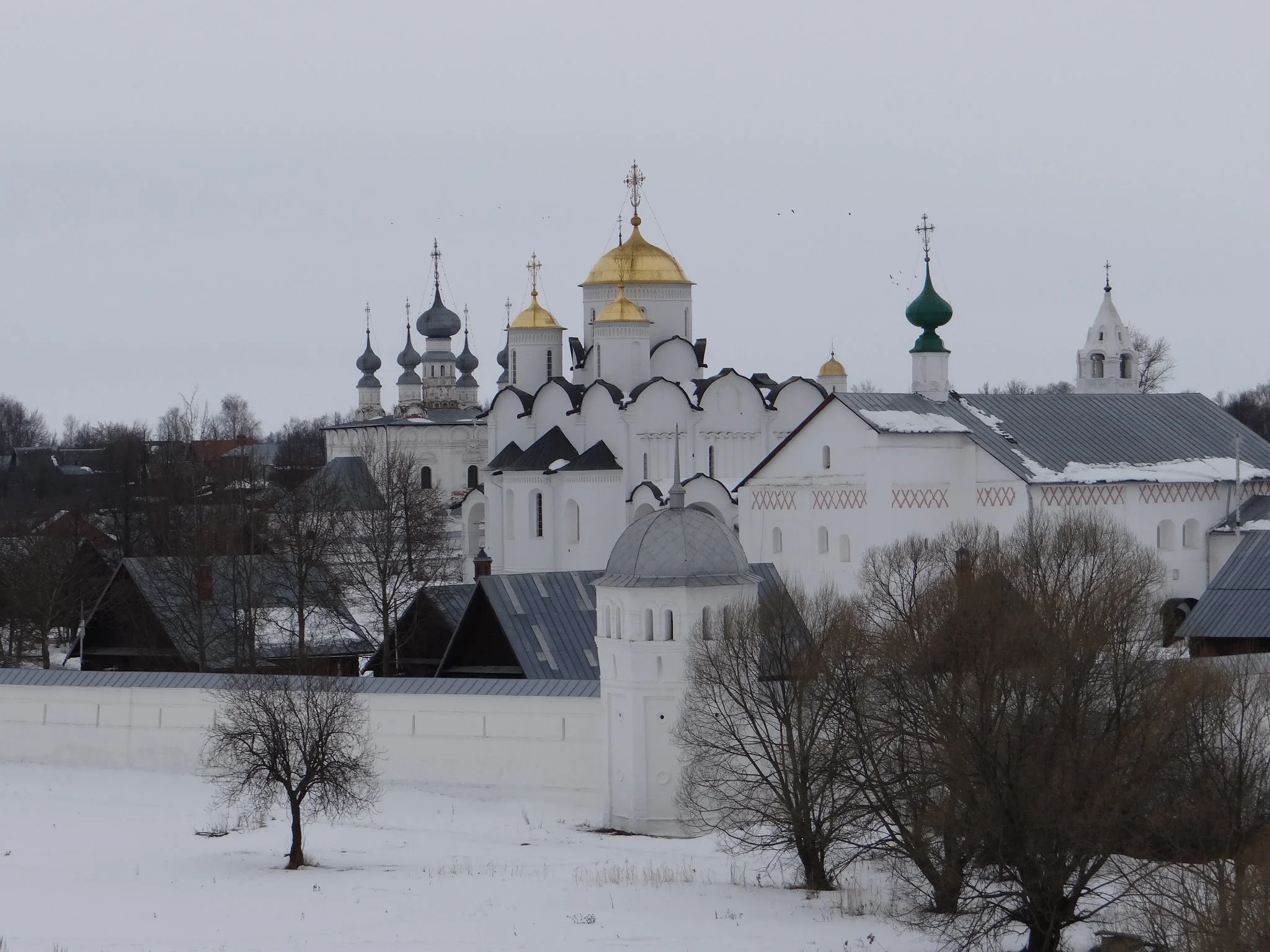
There are so many churches in Suzdal (more than 40 on some counts) that you’d better focus on just some of the main ones. Luckily for visitors, most of the buildings of note are concentrated around just two separate clusters at both ends of the city center, one around the 14th Century Monastery of Saint Euthymius, the other at the old Kremlin.

The Monastery of Saint Euthymius is, actually, a wall-enclosed complex that contains several buildings of religious, artistic and cultural significance.
Transfiguration Cathedral (Преображенский собор)
Uspenskaya Church' (Успенская церковь)
Nikol'skaya Church (Никольская церковь)


We joined a guided tour to visit the whole monumental ensemble. At the entrance it is possible to get guided visits in several languages and this is something I would recommend to anyone that is not well versed in Russian medieval history and art. Our guide was very professional and engaging.
The monastery is enclosed by quite a solid red brick wall, not unlike the one at the Moscow Kremlin, with several defence towers alongside it.
One of the curious facts about this monastery is that German marshal Paulus was imprisoned here after his defeat and surrender at the Battle of Stalingrad, during WW2.
There is a small museum that recalls this episode.
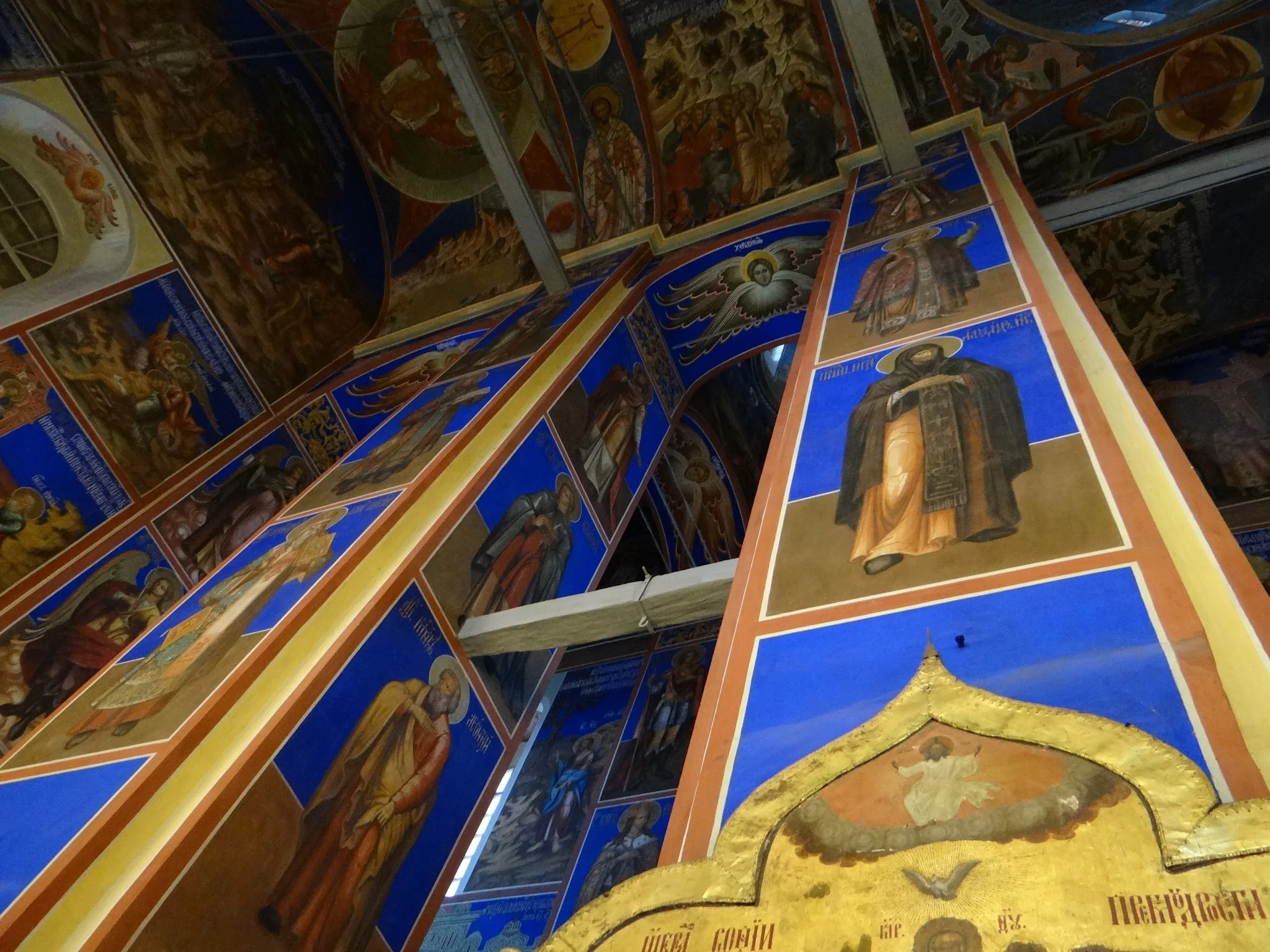
Even those that are little or not religious at all, will likely be awed by the amazing, colourful frescoes that decorate Suzdal’s churches.
They say an image is worth a thousand words, so here you have a small sample of what’s inside the churches at the Monastery of Saint Euthymius


The other focal point of interest in Suzdal is, of course, the Kremlin.
This is also a sort of sprawl within a closed territory (although the walls are partly gone, some of the ramparts are still visible). Here you will find:
The Cathedral of the Nativity (Рождественский Собор)
The Cathedral Tower Bell (Соборная колокольня), which is separate from the cathedral itself
Bishop’s Palace (Архиерейские палаты), which is currently a museum
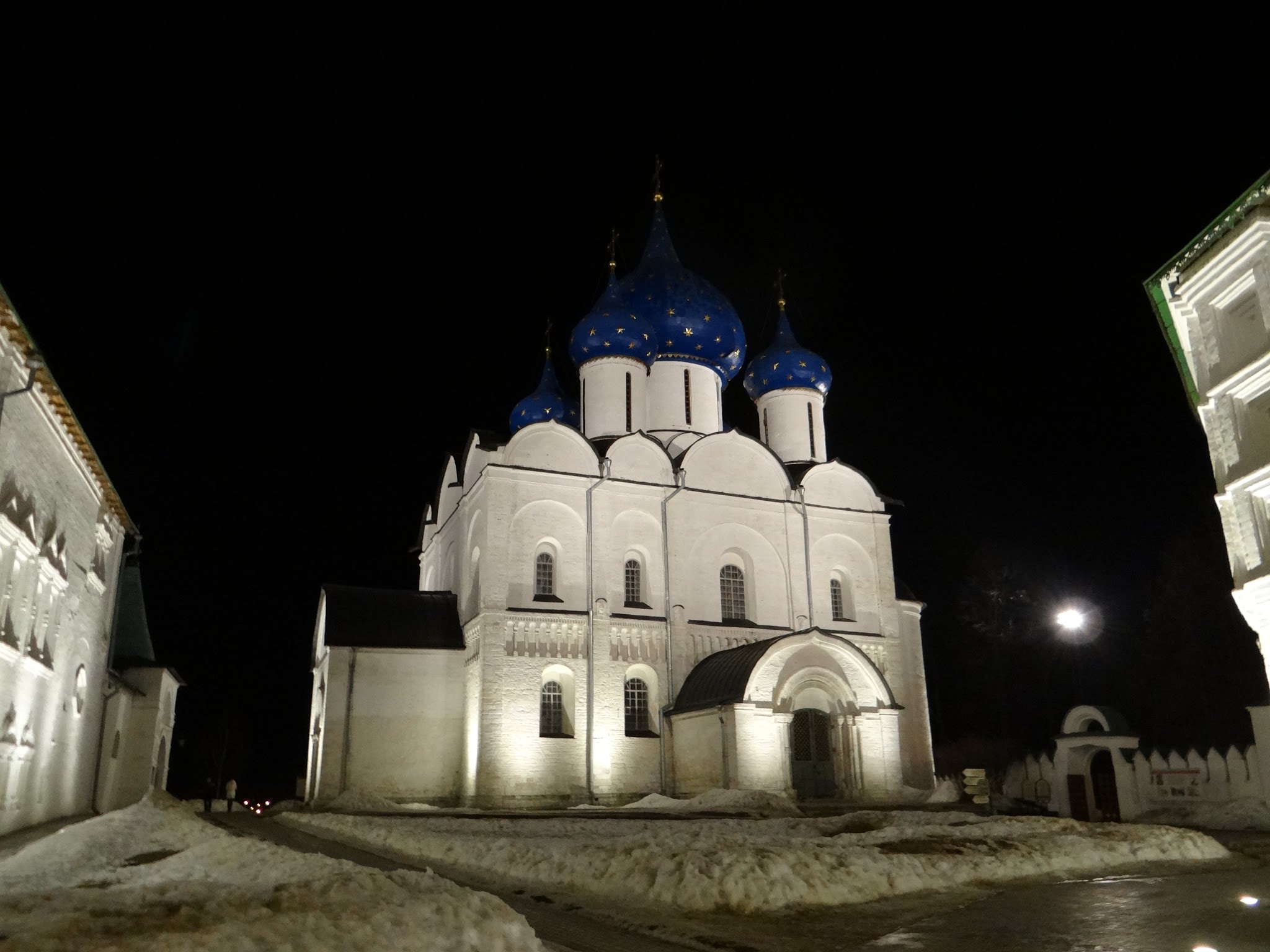
A night view of Suzdal’s Kremlin internal courtyard
But before you get a bit of an art overload, this chronicle wouldn’t be complete without a mention of the other things to do in Suzdal:
Conveniently located between the Monastery of Saint Euthymius and the Kremlin, in what passes for the town’s most central square (although, again, do not imagine the typical town square of most European historical towns, this concept can have a different meaning in Russia), there is a market.
Here you can get a feel of provincial Russia, with sellers in both indoors and outdoors stalls peddling an eclectic mix of products, from homemade jam and pickles to oil paintings.
If you are looking for souvenirs to take home, there are also several shops nearby.
Two local products that may be worth checking:
1) Medovukha, a sort of honey-flavoured beer
2) “Valenki”, traditional Russian felt boots, which are very useful for the Winter


Suzdal’s market square


Street selling of homemade pickles and confiture is a Russian classic, but here in Suzdal it is taken at a whole new level
Where to eat in Suzdal?
I can speak of two places:
Restaurant “Trapeznaya”, that advertises itself as serving 300-year old dishes (with fresh ingredients, hopefully!). When I dined there it occupied part of an old building by the Kremlin complex. Food was good, with some large dining halls and stone walls that gave it quite a “historical” atmosphere (however, it when I checked it again to write this post the restaurant seemed to have moved to a new location further down the road, so better double check the exact address or, even better, call to confirm before going!)
Restaurant Chainaya, Kremlyovskaya St., 10G
Located on a wooden building next to the river and also right by the Kremlin, this is quite a cozy place serving traditional Russian dishes (see the pics below). It has a courtyard lined with some souvenir shops. Definitely recommended.

The restaurant Chainaya, our pick to eat in Suzdal

Places to stay in Suzdal
Hotel Zolotoy Ruchey (Отель Золотой Ручей)
Address: Ulitsa Lenina, 72; http://www.gold-river.ru
Relatively small hotel with big rooms. The whole building is also in the traditional wooden Russian style. Be warned, the decoration can be a bit kitsch (nothing to do with the contemporary minimalist style that is in fashion nowadays), but the facilities are modern and clean and service good. Very centrally located.
Great value.
…and, there are some bears throughout the property! You are in the heart of old Russia after all!
