
Top things to do and see in Franconia (III): Fürth, the “Franconian Jerusalem”
After visiting the beautiful historical towns of Bamberg and Forchheim, the next stop in my Franconian tour was the city of Fürth.
Now, if you look it up on the map, you will see that Fürth is today pretty much integrated into the greater Nuremberg urban agglomeration.
However, this Franconian city of more than 130,000 people has a rather rich and interesting history of its own and it is well worth a visit.
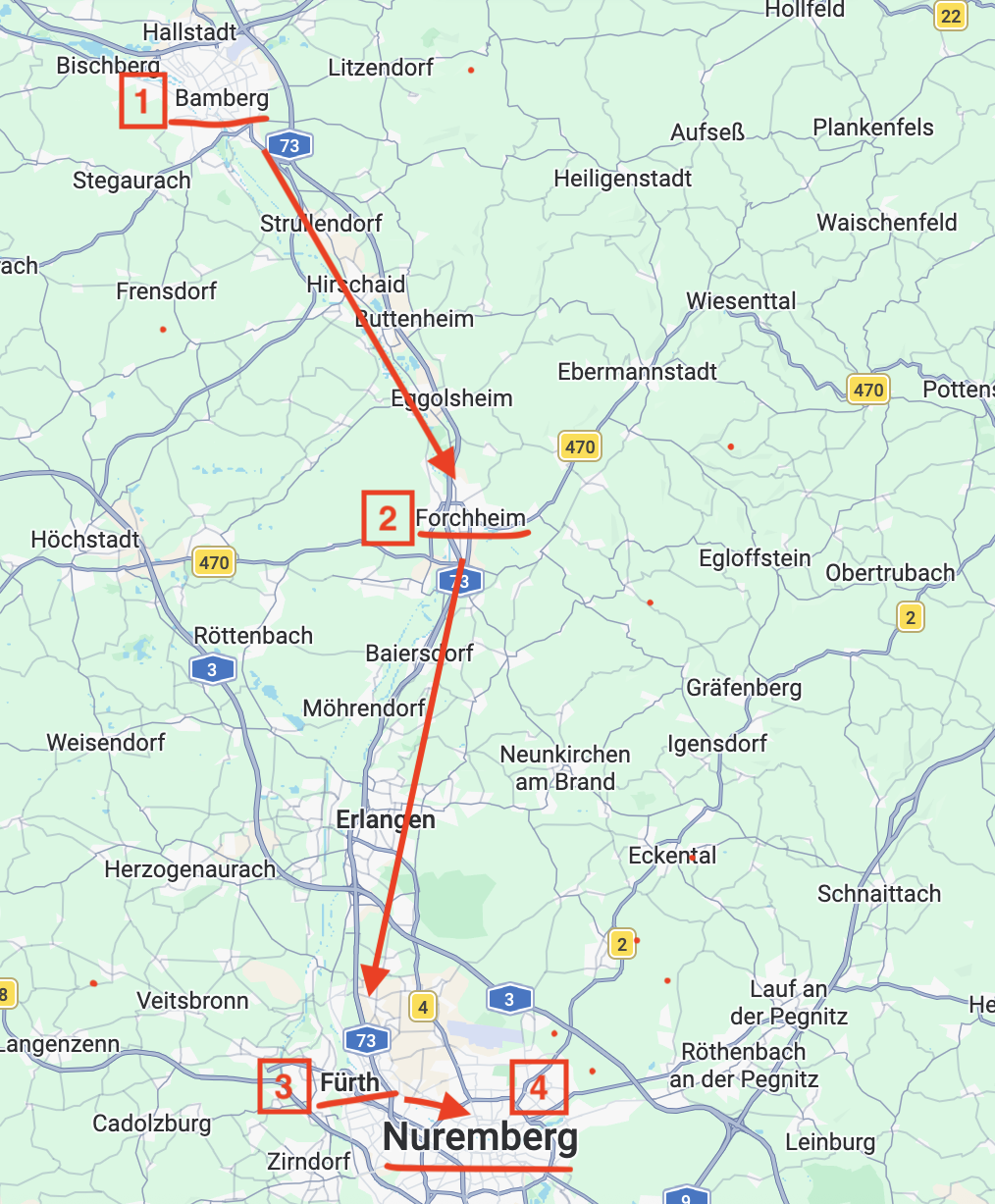
Fürth has enough to keep you going for a full day and it can also be visited as a day excursion from Nuremberg (since their urban transportation networks are interconnected, including the metro and S-Bahn, the suburban train system).
So, on this post I will share my impressions of my visit to Fürth and its main landmarks.
Here are some of the topics you will find next in this post:
The growth of industrial Fürth & its Italianate town hall
The Jewish heritage of Fürth
Protestantism in Fürth and the 30-Year War
The historical town of Fürth
Henry Kissinger’s birthplace in Fürth
Where to eat Franconian food in Fürth
This post may contain affiliate links. If you book or buy something through them, I earn a small commission, at no extra cost to you. It's one of the ways I keep Places of Charm going. Thank you for your support.
I would like to thank also Franken Tourismus and the Fürth Tourist Office for facilitating this journey and arranging a tour of Fürth with the great local guide Monika. All opinions are my own.
Walking around Fürth
Fürth is quite an old city, the origins of which can be traced back to the early Middle Ages.
In fact, its name is possibly derived from the old Germanic word for “ford” since Fürth sits at the confluence of the Pegnitz and Rednitz rivers (which join together a bit north of the city to form the Regnitz, the river which we have already seen in Bamberg and Forchheim earlier in this series).
While Fürth has grown over the centuries somehow under the shadow of the much larger (and Imperial) neighbouring city of Nuremberg, it has always had a very strong character of its own.
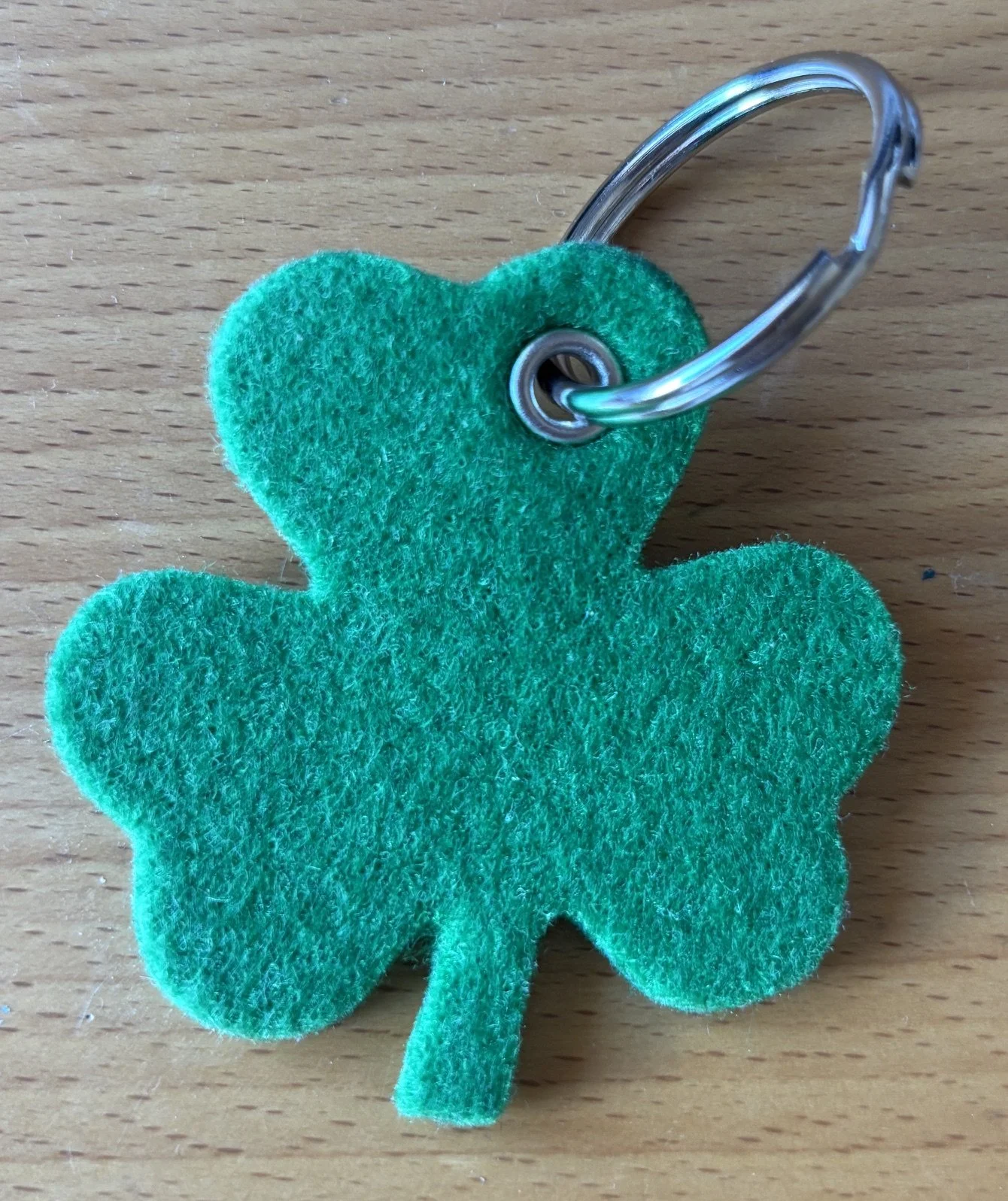
This is reflected today in some symbols of local identity, such as the cloverleaf, which is visible in quite a few urban ornaments (no connection with Ireland that I am aware of!). In past centuries, however, Fürth distinctive status in the German political order was based on a rather unusual political set up in which three entities shared power over parts of the city: the Princely Bishopric of Bamberg, the Principality of Ansbach, and the City of Nuremberg.
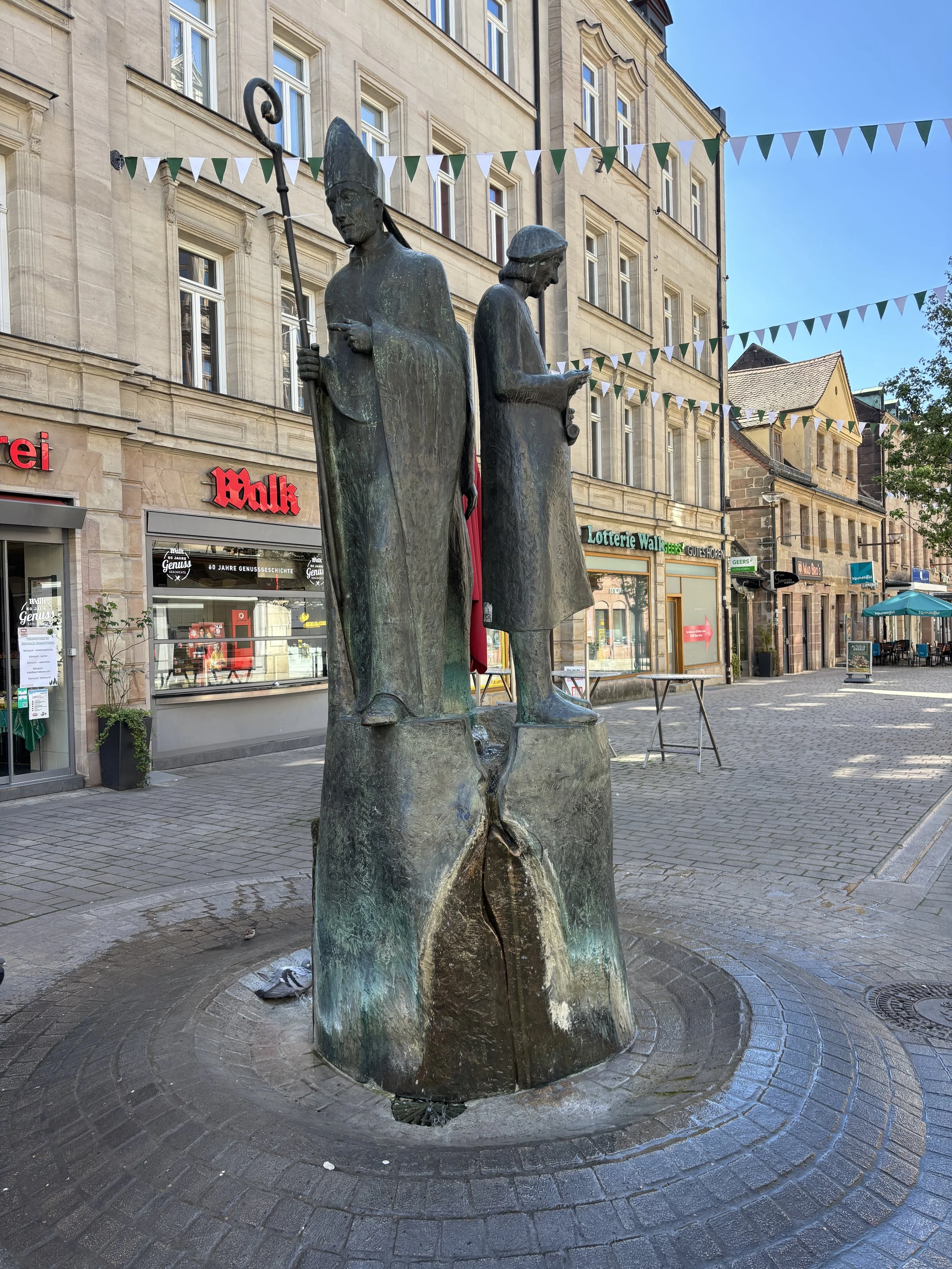
By the way, these three powers are depicted in one of the statues that adorn Fürth’s main commercial street (picture to the right).
This means, that, while very close to the Imperial city of Nuremberg, Fürth could sometimes carve its own path. For example, in the early 16th C., when many German territories, including the city of Nuremberg, were expelling their Jewish populations, Fürth welcomed them (in exchange of a “protection fee”, truth be told). This led, over time, to earn Fürth the nickname of “Franconian Jerusalem”, a topic we’ll revisit further down this post.
Another particularity of Fürth is that it was a Protestant stronghold in highly Catholic Franconia, this led to it being also the setting of some big military clashes in the 17th C. during the 30-Year War, something we’ll touch upon later in this post, as well.
So, Fürth evolved as a rather diverse cultural and religious entrepôt all the way to the industrial era, which Fürth also embraced wholeheartedly, becoming not just a major industrial centre but also the terminus of the first railway in Germany, which linked it to Nuremberg.
So, now, without further ado, let’s see what the city has to offer to the visitor today and my suggestions about what to do and what to see in Fürth.
Fürth has managed to preserve a small, nice historical center, however, the city has remained far from stagnant through the last five hundred years. In fact, most of Fürth’s current downtown is the product of the industrial revolution. Since the 19th C. Fürth became home to industries such as gold-beating, toy manufacturing, mirror production and electronics (radio and household appliances giant Gründig was founded in the city).
This gave Fürth the wealth and prosperity that allowed it to fund a world-class urban development program in the 19th C. and early 20th C. with broad avenues, elegant multi-storey buildings, department stores and a number of singular public buildings.
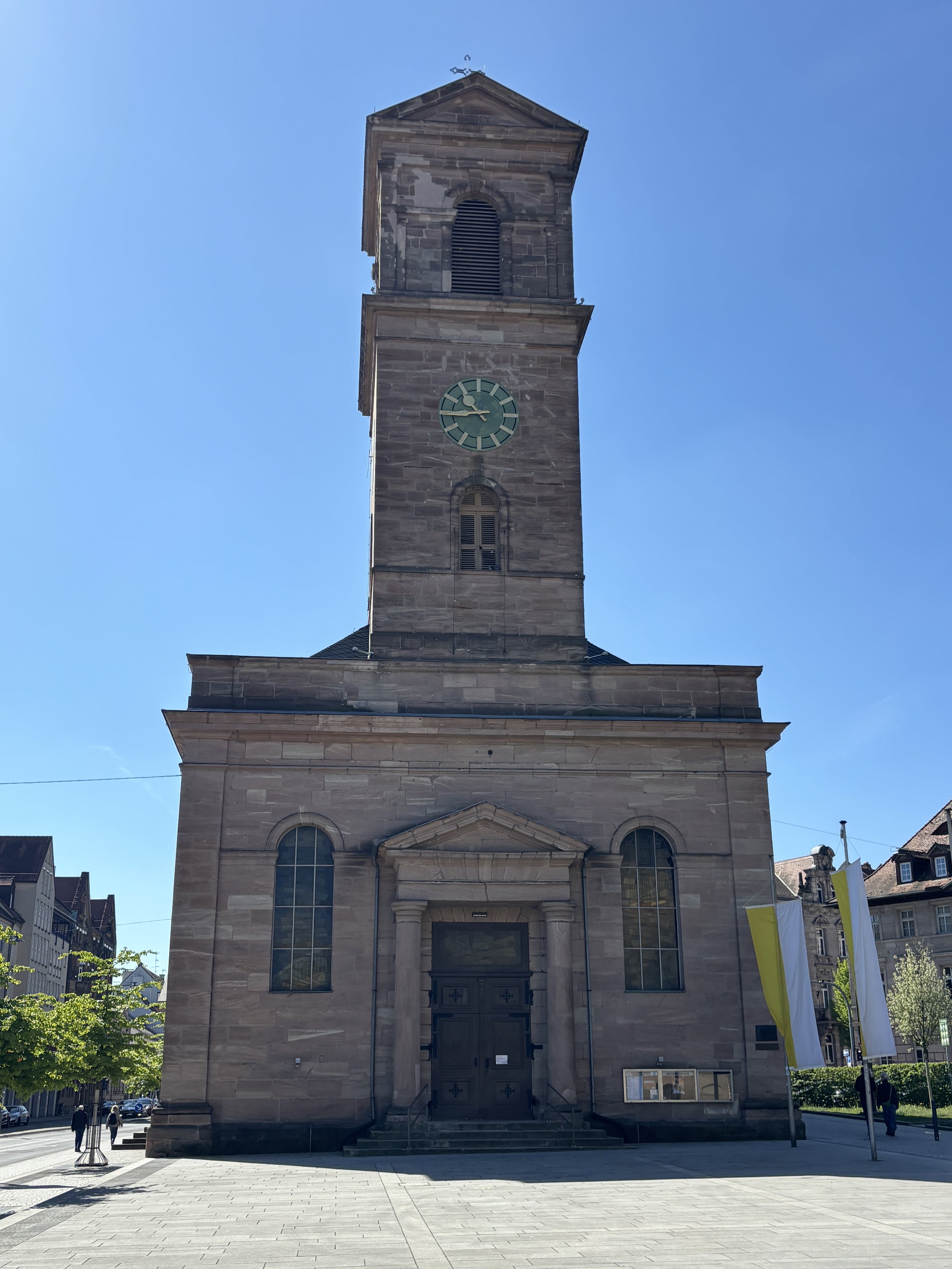
Among the latter was the Church of Our Lady, built in 1829, not long after Fürth joined the strongly Catholic Bavarian kingdom in 1806. Remarkably, the Church was built with voluntary contributions from the Protestant and Jewish communities.
Another civic venue which in the city which was built through citizen contributions (in this case with a major involvement of the city’s Jewish community) was the city’s majestic theatre venue, which was completed in 1902.
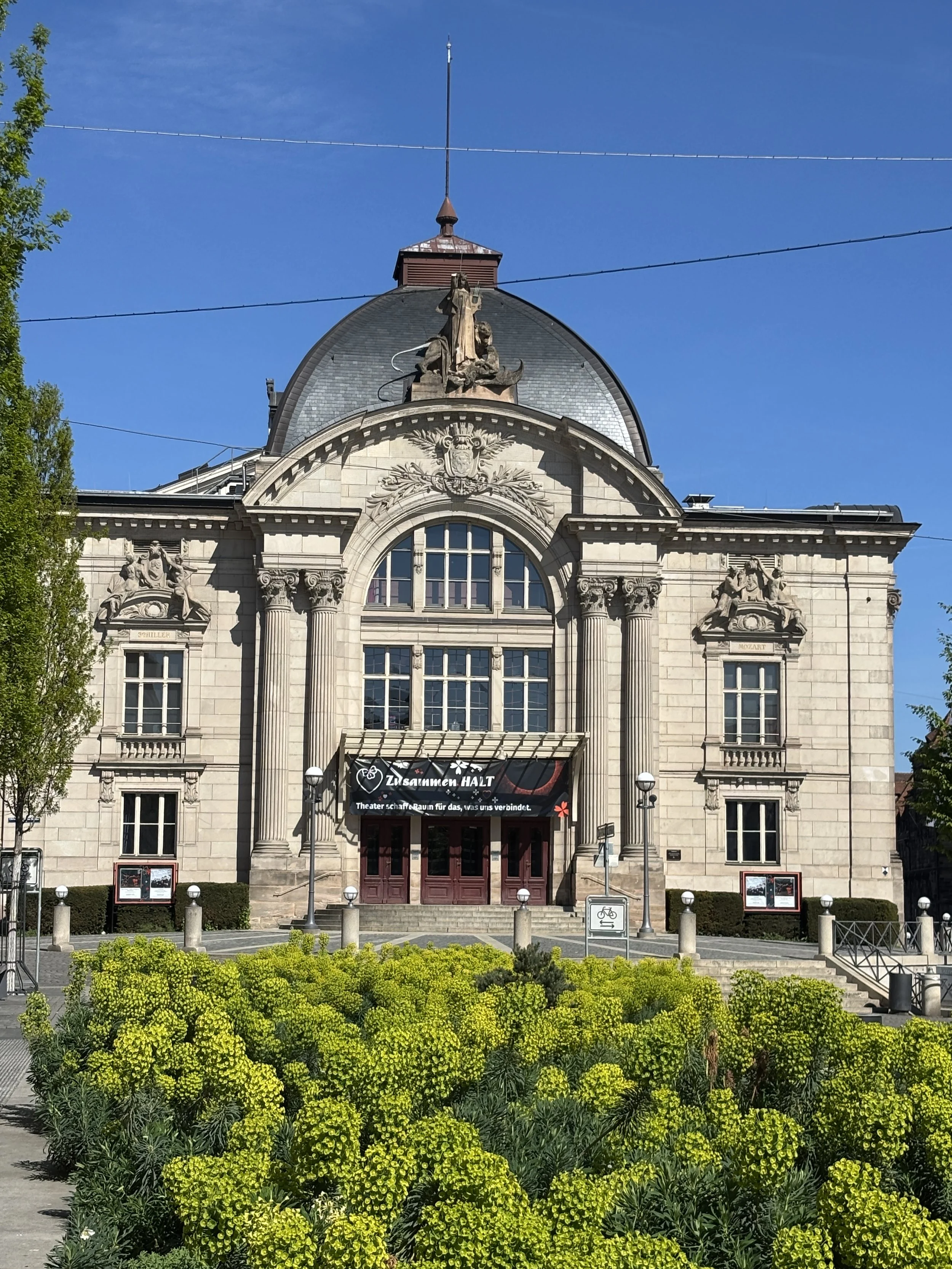
Interestingly, the architect that designed Fürth’s theatre used the blueprints it had devised for another theatre which had been commissioned to be built in what was then Czernowitz, in the Austro-Hungarian Empire (now Chernivtsi, in Ukraine). So the two cities did get eventually (more or less) the same building!
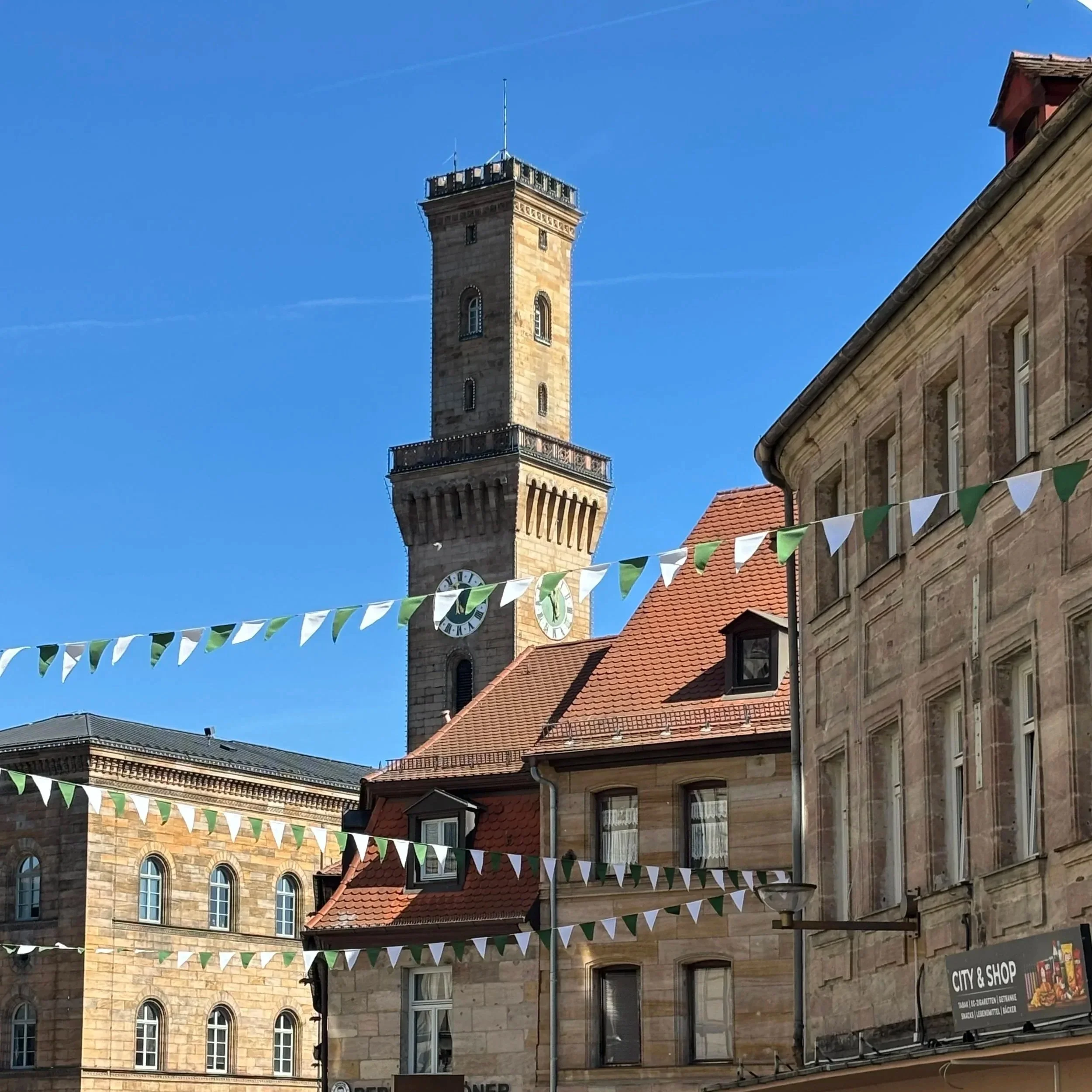
But perhaps the most eye-catching element dominating the Fürth skyline is the town hall, which was designed in the mid-19th C. If it reminds you of an Italian scene, it’s for a reason!
In their quest for something extraordinary, the citizens of Fürth decided that their city needed a replica of Florence’s Palazzo Vecchio as their new town hall!
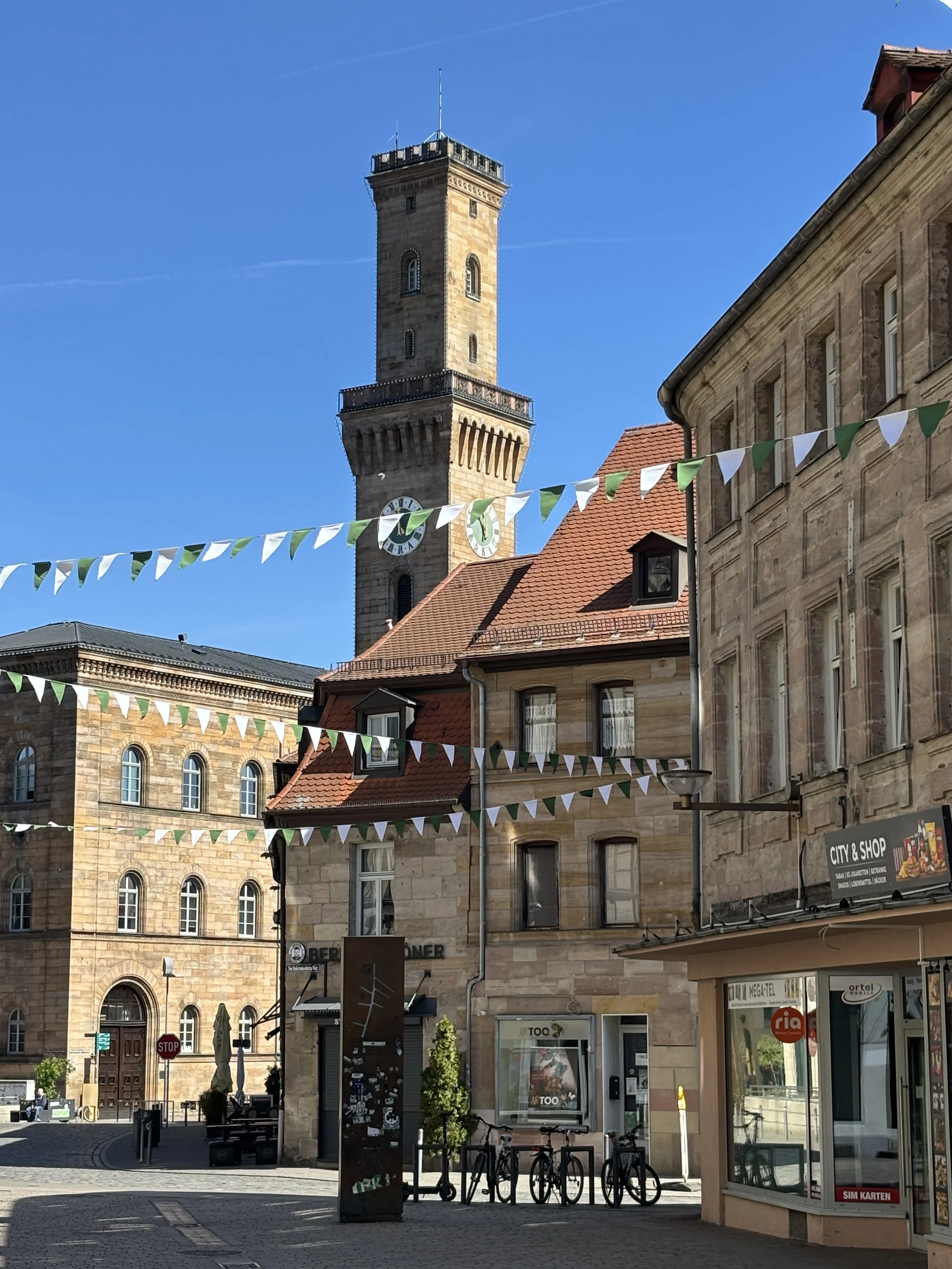
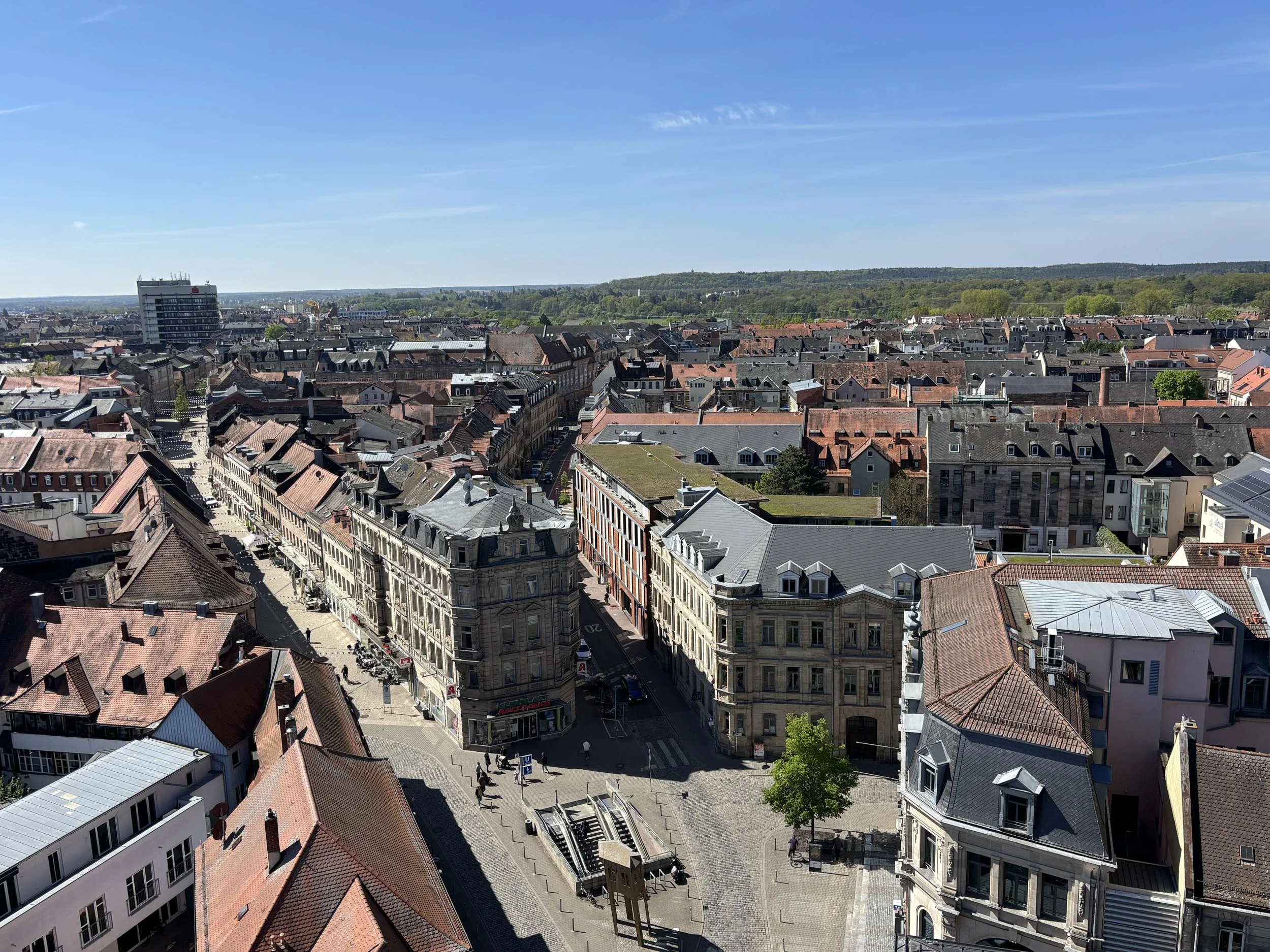
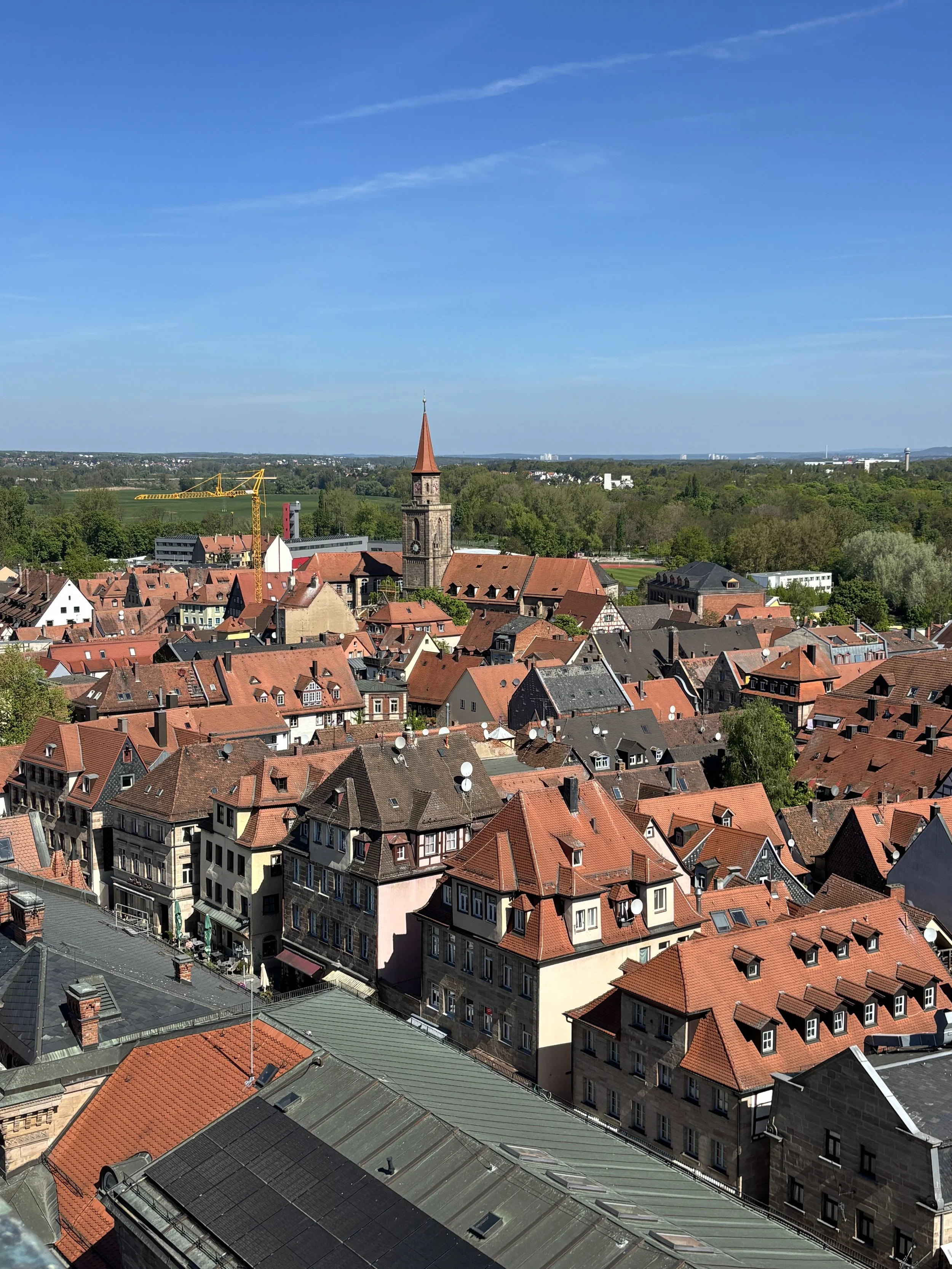
It is possible to get to the top of the Town Hall tower to get a 360º panorama of the city of Fürth, with the city’s two well-defined parts, the old and modern ones, as well as the surrounding countryside and as far as the city of Nuremberg, the main landmarks of which are perfectly visible in the distance.
The Jewish Heritage of Fürth, the “Franconian Jerusalem”
We have already mentioned how Fürth became a safe haven for Jews which, in the 16th C, had to flee other parts of Germany.
Over the next few centuries the Jewish community of Fürth kept growing and the city became, actually, a very dynamic center of Jewish learning to the point that it became known as the “Franconian Jerusalem”.
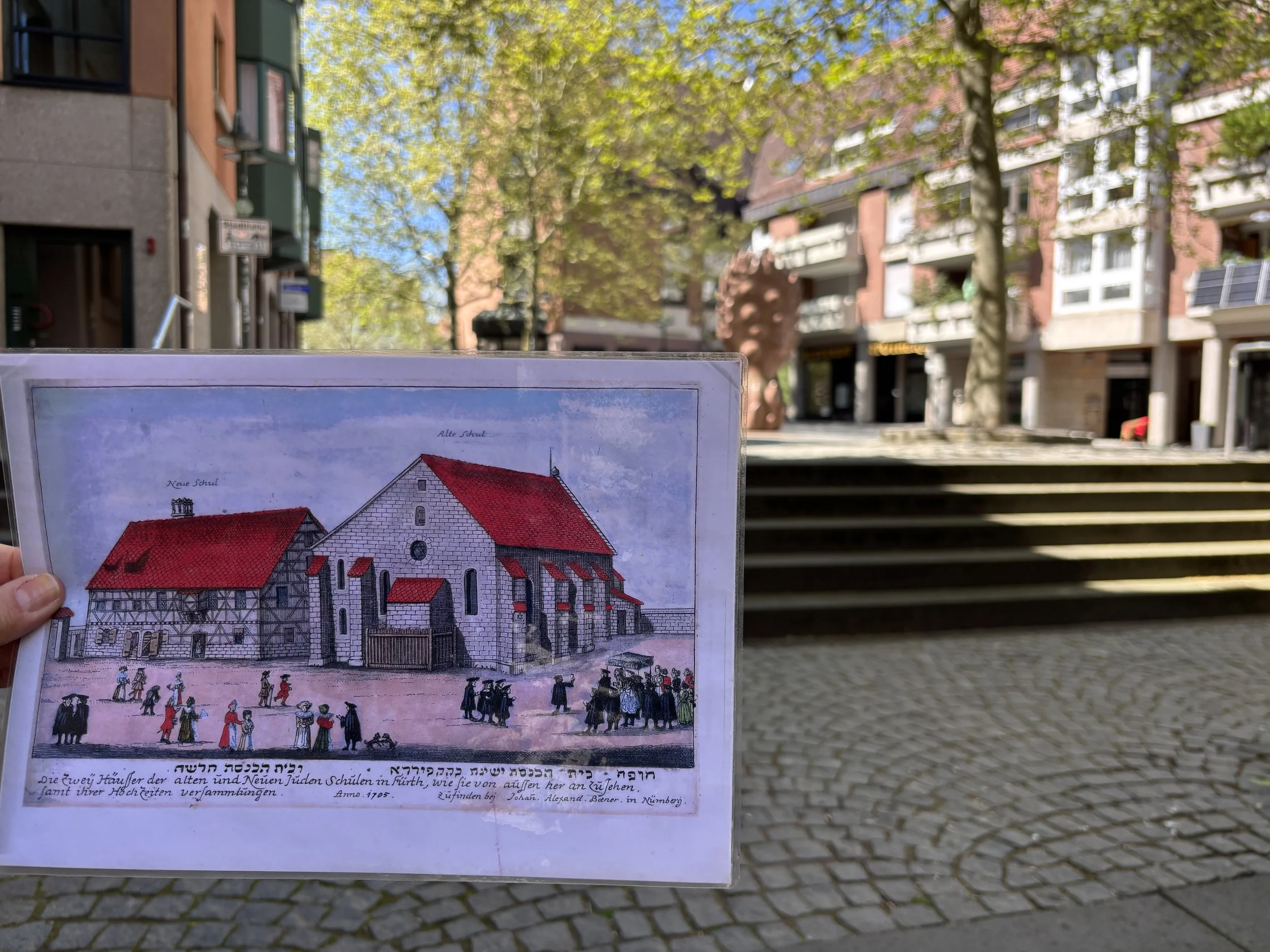
The hub of Jewish cultural life in Fürth was an area called the “Schulhof” (or “School Courtyard”), which was exactly that: several centers of learning and prayer structured around a large open courtyard.
This part of Fürth’s history came to an abrupt end in the 1930s with the rise of Nazism in Germany. As it happened to other Jewish communities in Germany and Europe, the Nazis targeted Jews in Fürth and razed the Schulhof to the ground.
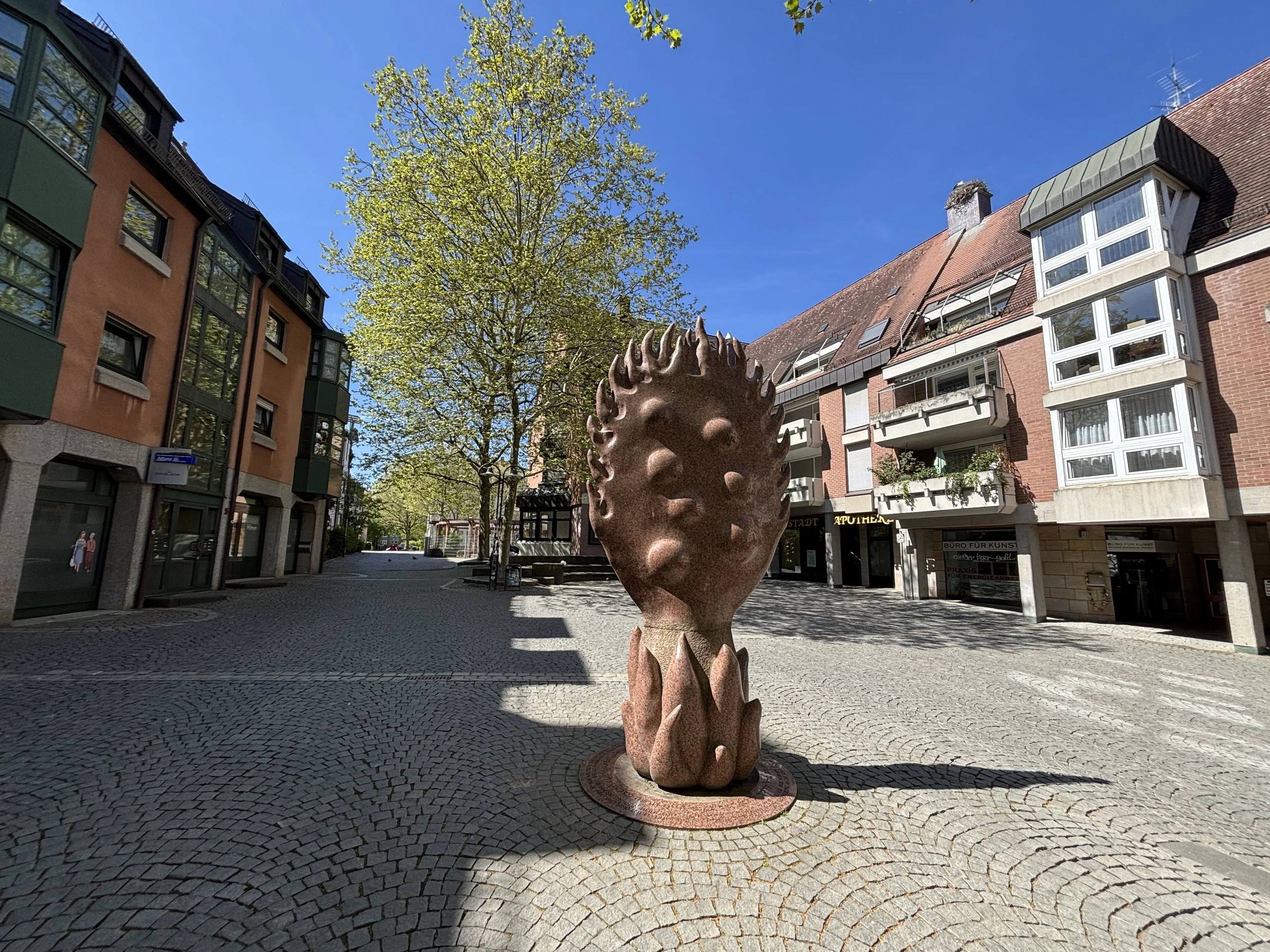
What you see today is an ensemble of modern post-war constructions more or less laid out around that central courtyard. A monument by Japanese artist Kunihiko Kato, now stands in the middle of the courtyard remembering that past and what happened to it.
Fürth has other sites connected to the Jewish past of the city, although I was not able to visit them all due to time constraints.
For example, there is also a Jewish Museum, which has been housed by a modern purpose-built facility since 2018 and documents the history of Jewish life in Fürth and Franconia.
Another interesting site is the old Jewish cemetery, which is located in the outskirts of the old town. Since it is no longer in use, vegetation has covered most of the large patch of land in which is located, including many of the old tombstones, giving it a somehow remarkable aspect, which invites contemplation and remembrance.
Visiting the historical center of Fürth
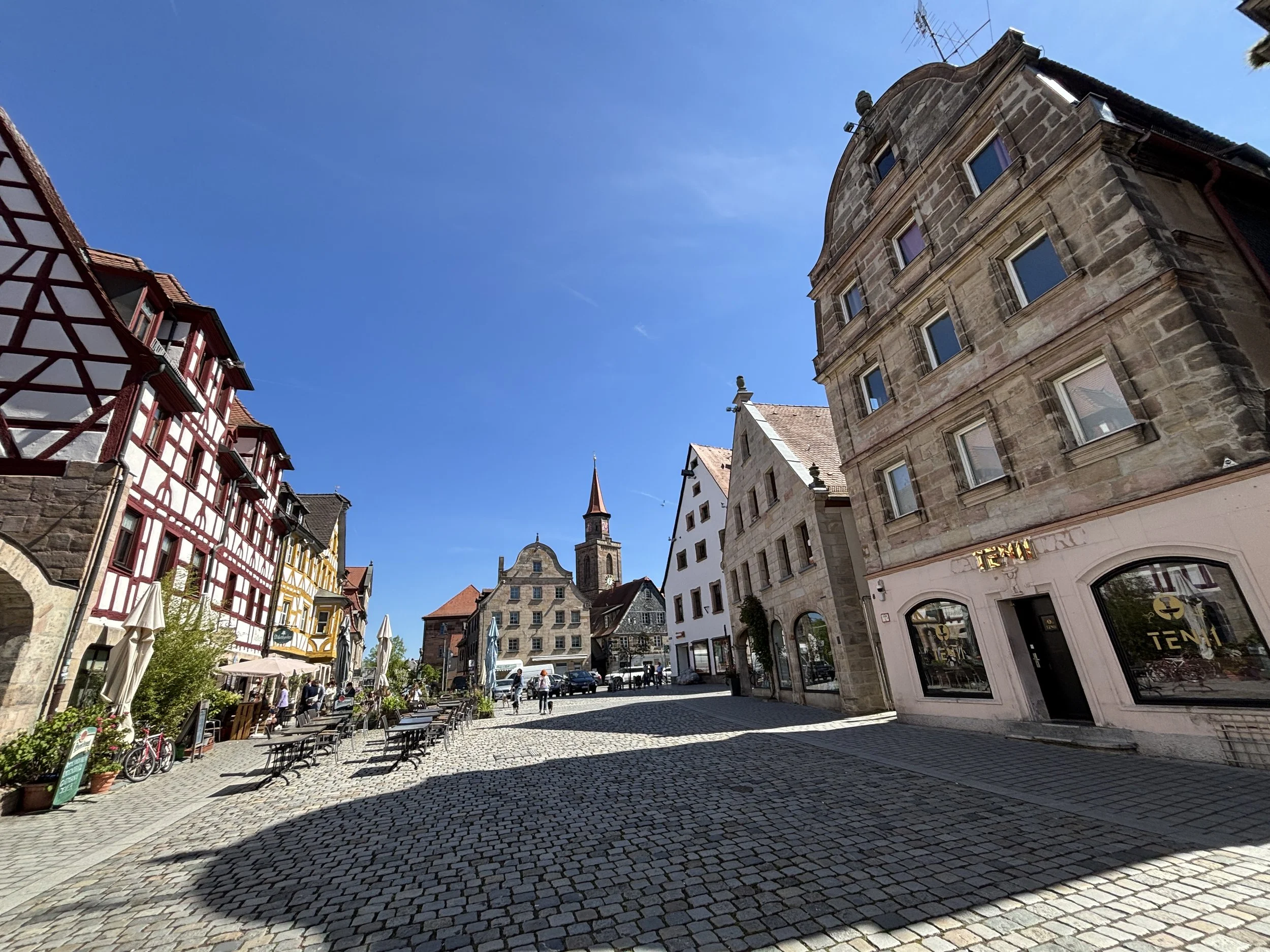
Continuing our walking tour of Fürth, we get to the historical town, which is not large, but survived WW2 pretty much intact.
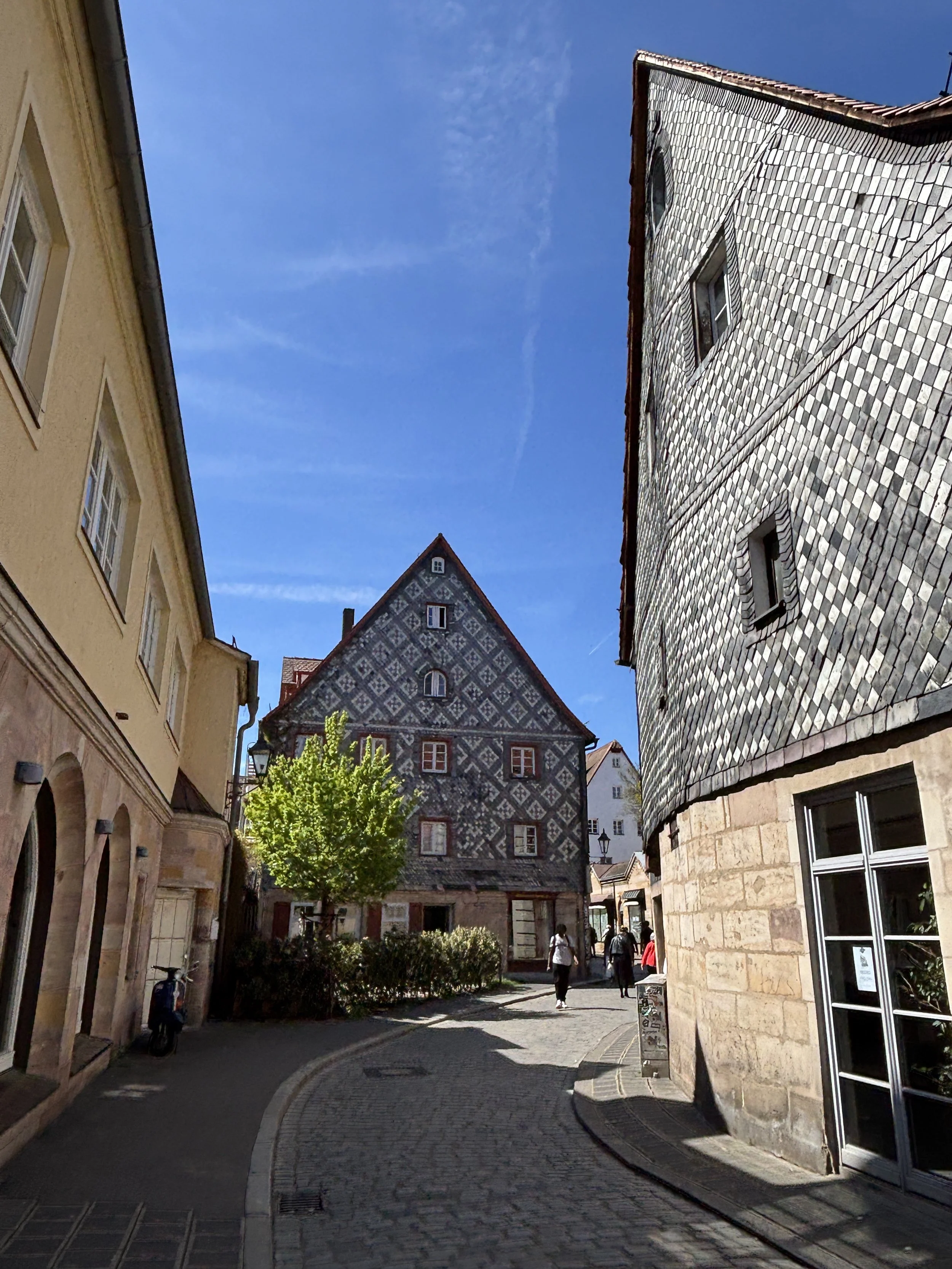
Like many other historical German cities, Fürth has its fair share of half-timbered buildings, but if there is one aesthetic aspect for which this city stands out is its slate-clade facades.
Here, in Fürth, slate panels have been used profusely to cover all sort of surfaces, not just the roofs. Valued because of its insulating properties, slate is in facades and side-walls, often covering most of the building. In many places it is also possible to find facades which have been decorated by using patterned slate coverings.
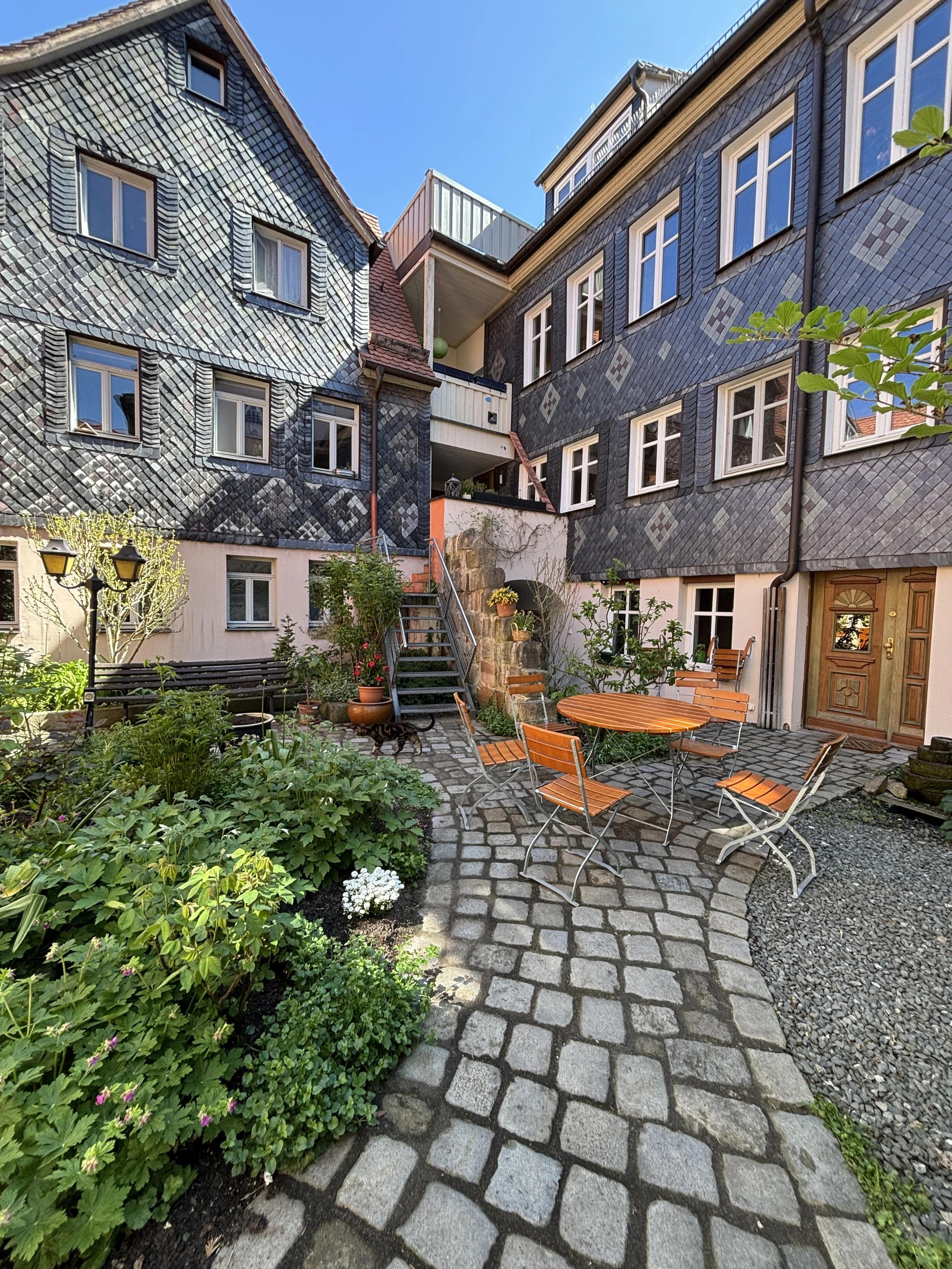
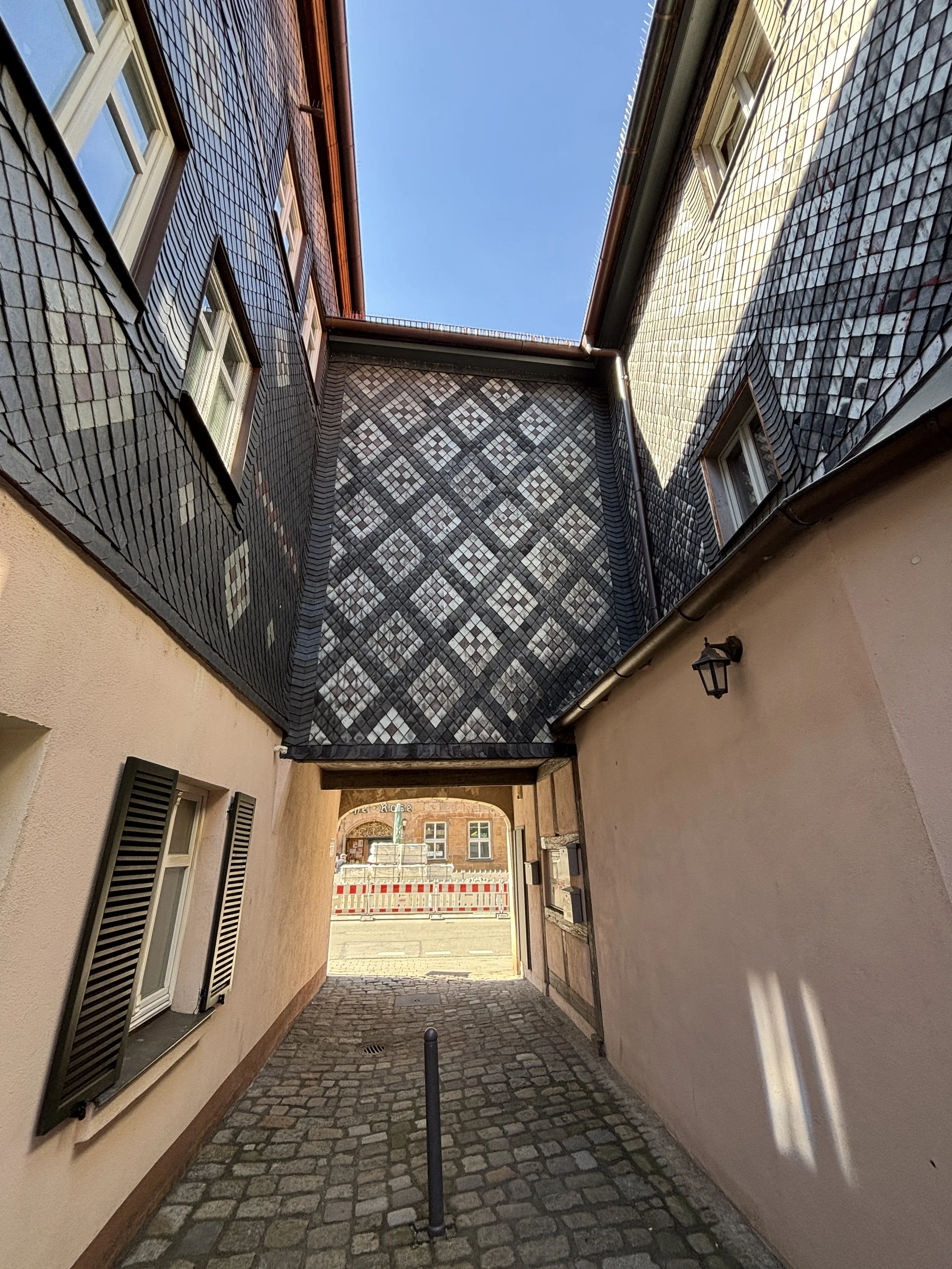
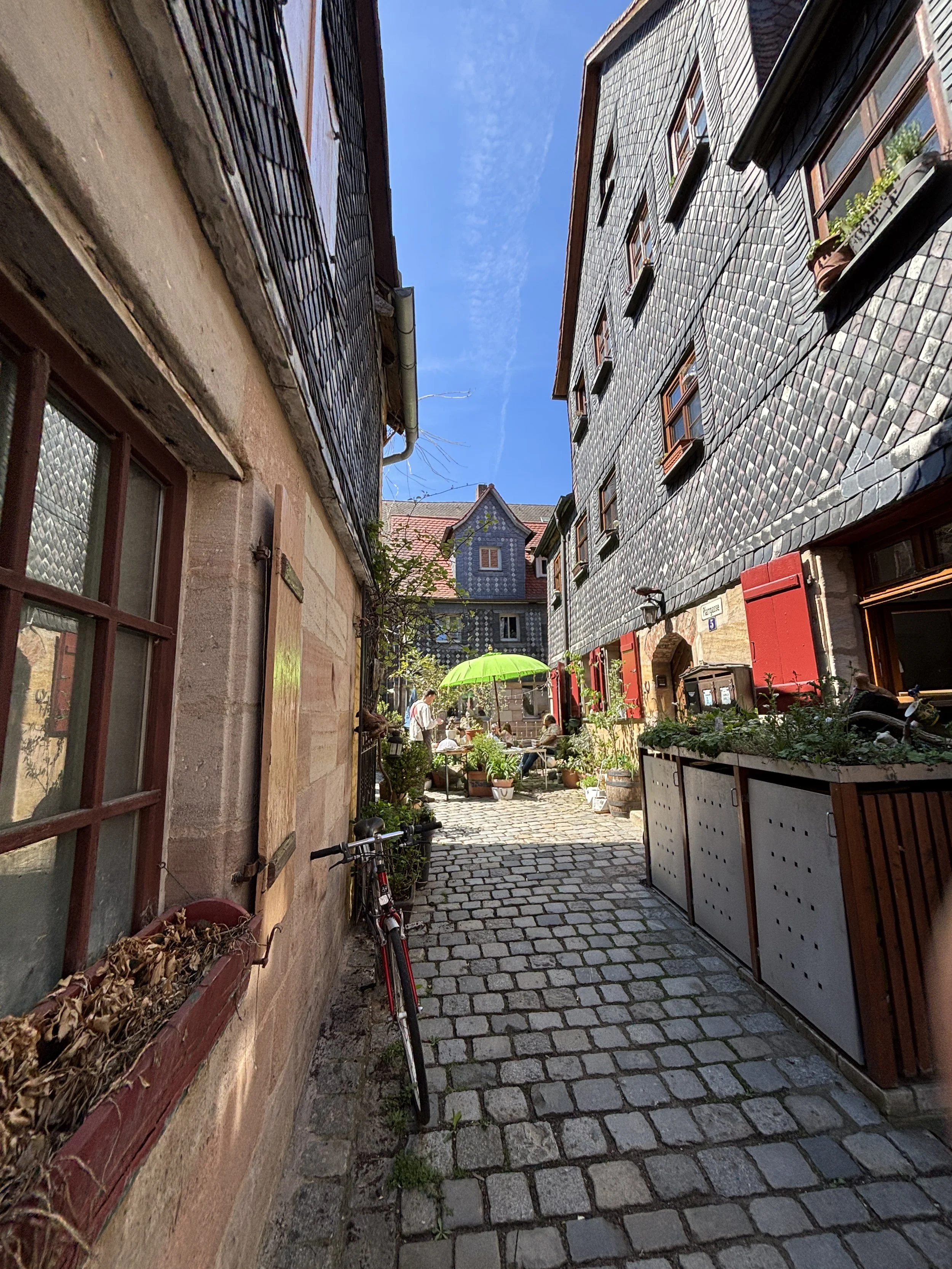
The other thing that historical Fürth stands out for is the abundance of little courtyards, some public, some semi-private, many of them perfectly well kept as gardens.
This phenomenon may be partly explained by the location of Fürth on a major axis of communication linking Nuremberg to Frankfurt and other major German cities. With Nuremberg a mere five miles away, the city of Fürth made a convenient overnight stop before being able to cross Nuremberg’s city gates in the morning. the courtyards provided a a safe place for travelers to leave their horses or carts for the night while sleeping at the adjacent inns.
Protestantism and the Thirty Years War in Fürth
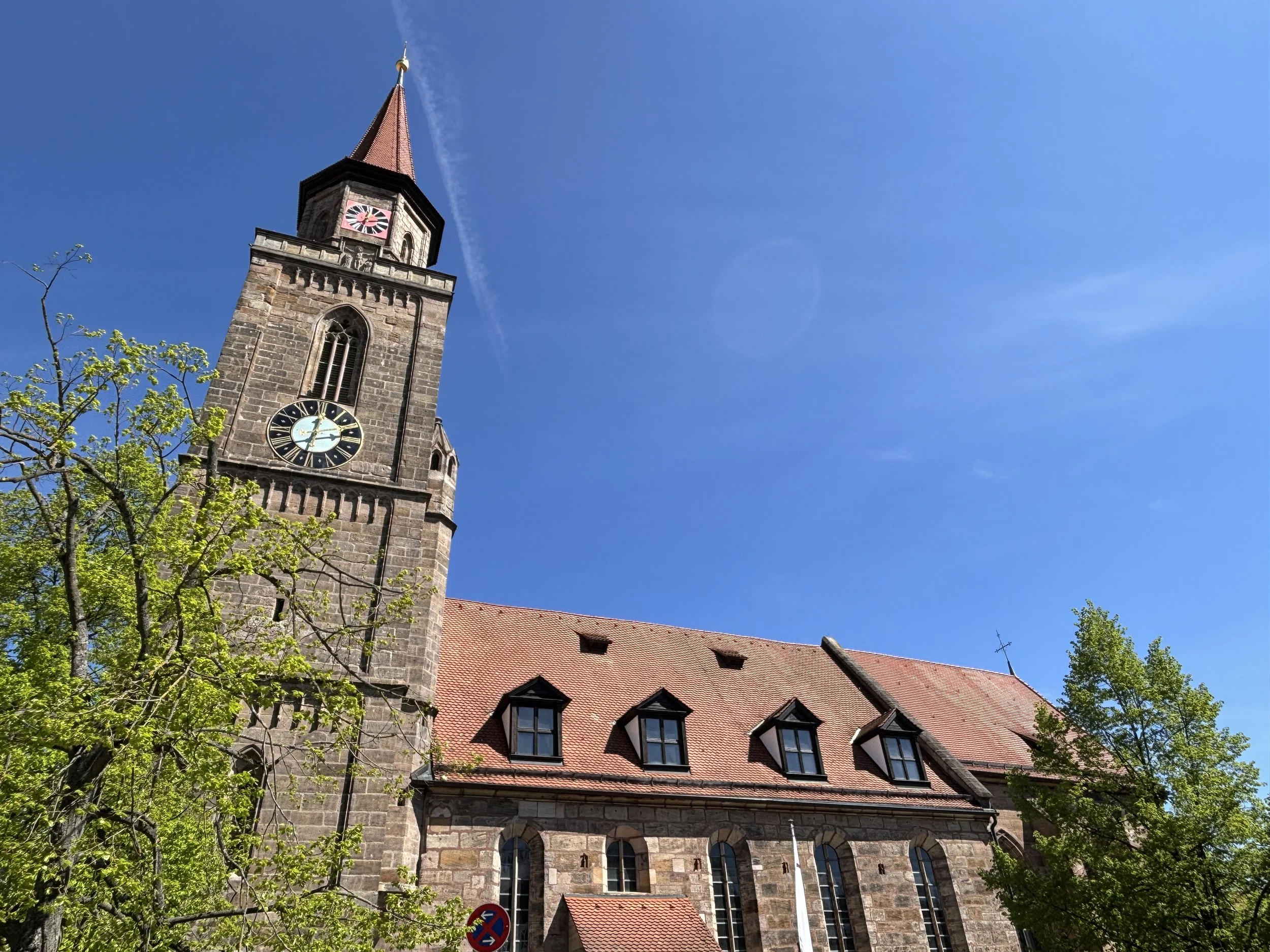
Fürth has also the particularity of being a majority-Protestant city in Catholic Bavaria. Fürth main Protestant church is Saint Michael’s, which is credired with being, possibly the oldest building in town, as well.
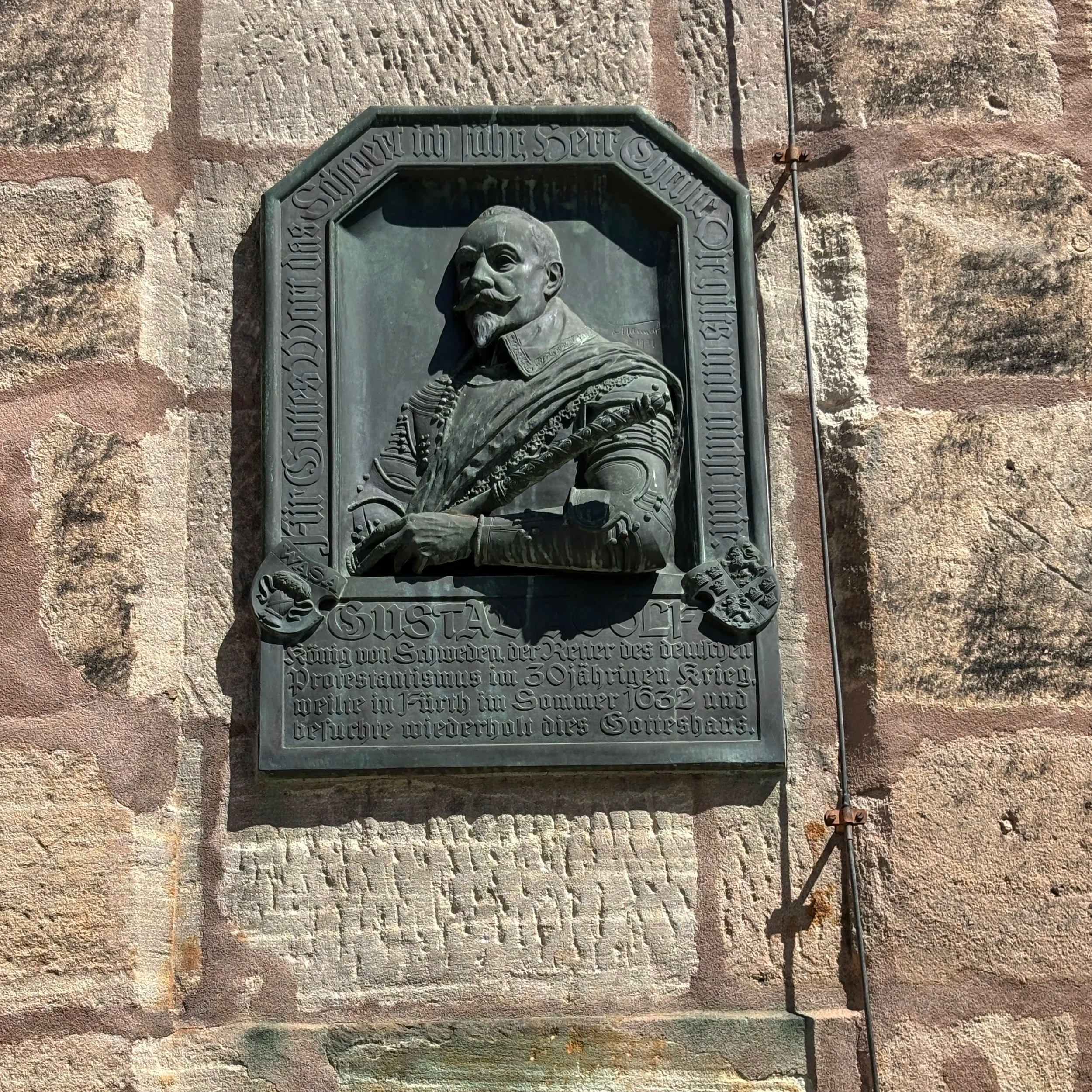
Fürth’s protestantism meant that in 1632, during the Thirty Years War, it hosted the King of Sweden, Gustavus Adolphus, which styled himself as a major defender of the Protestant cause in German lands.
The Swedish king is still remembered in Fürth, where a plaque and a bust remembers the royal visit. Gustav Adolphus apparently lodged at the rectory adjacent to Saint Michael’s church in June 1632. One of Fürth’s main streets is also named after the Swedish monarch.
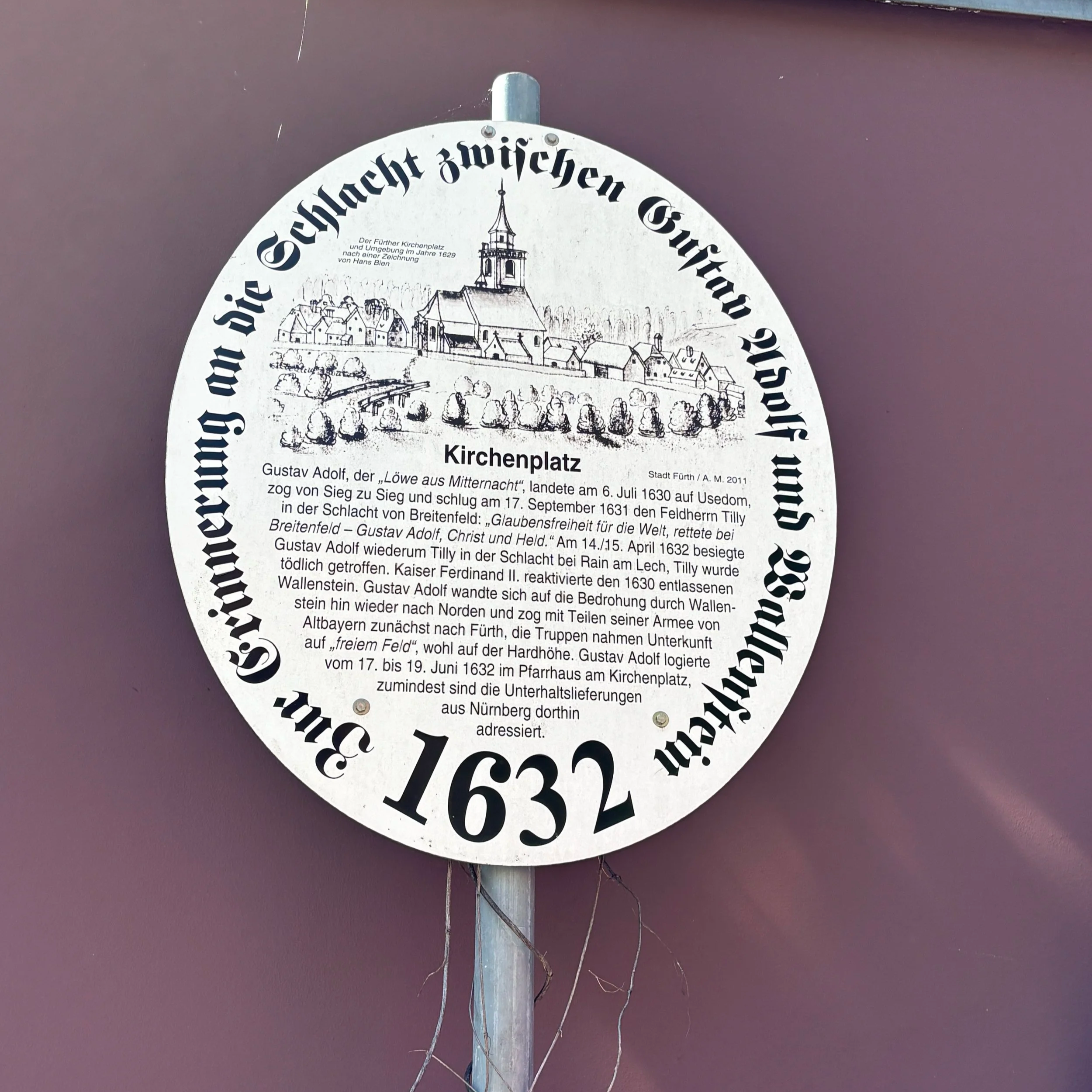
Gustav Adolphus campaigning in the area of Fürth culminated in a battle at a nearby hill called Alte Veste (“Old Fortress”). There, after a prolongued stand-off, Swedish forces charged the Imperial army under the command of Albrecht von Wallenstein, with the latter reportedly getting the upper hand. The city of Fürth and the surrounding countryside reportedly suffered quite a lot of damage during that conflict.
Visiting Henry Kissinger’s birthplace
Fürth is the birthplace of two prominent statesmen.
One of them was Ludwig Erhard, who was Finance Minister of the German Federal Republic under Adenauer and later, between 1963 and 1966, Chancellor himself. A remarkable man who is widely credited with being one of the architects of the German post-war economic miracle (the so called “Wirtschaftswunder”).
The other major statesman born in Fürth is none other than Henry Kissinger, the formidable US Secretary of State.
Kissinger served in this capacity between 1973 and 1977 under Presidents Nixon and Ford, and later remained a very prominent and influential voice in international affairs pretty much until his death in 2023, at the venerable age of 100.
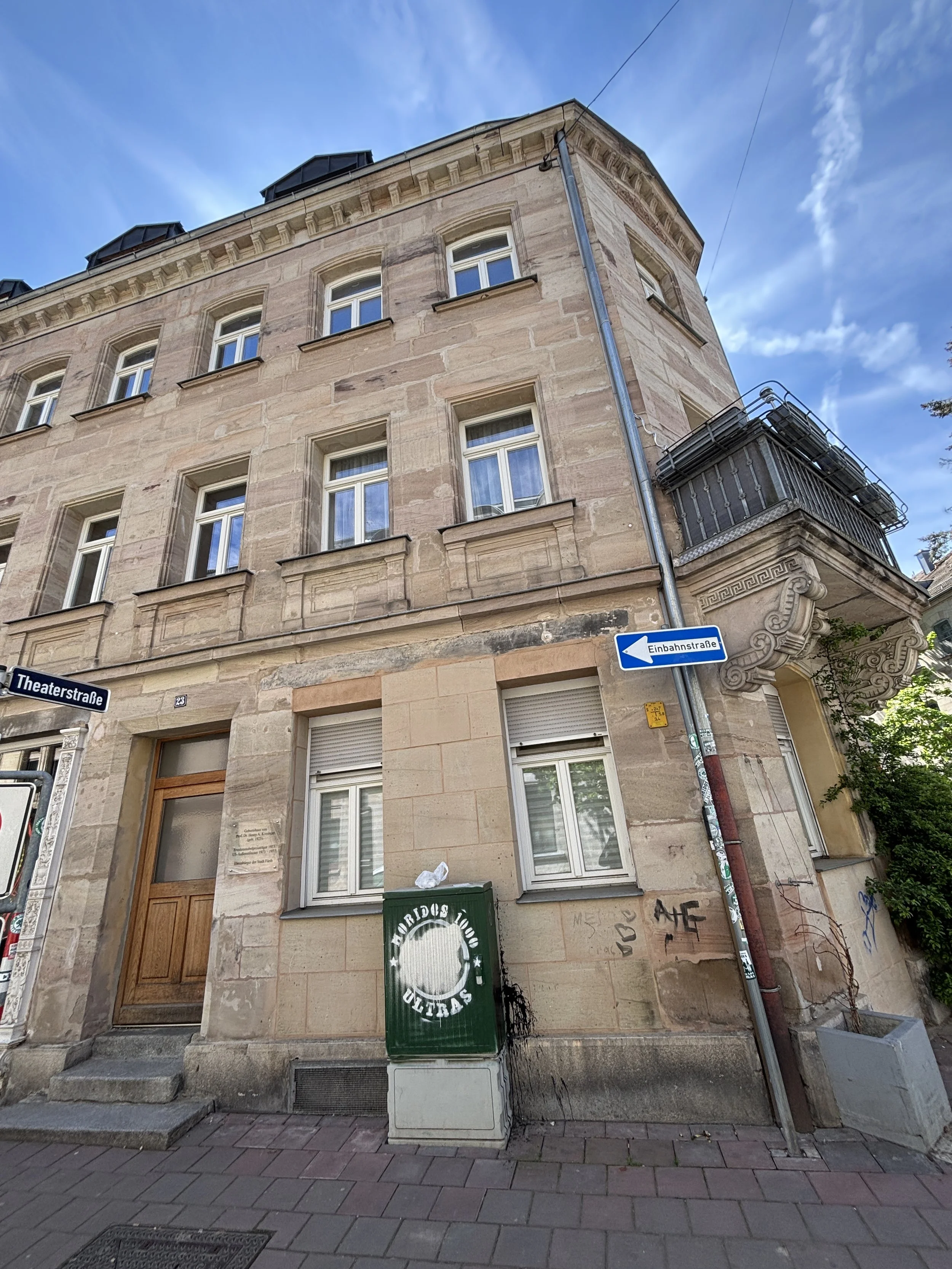
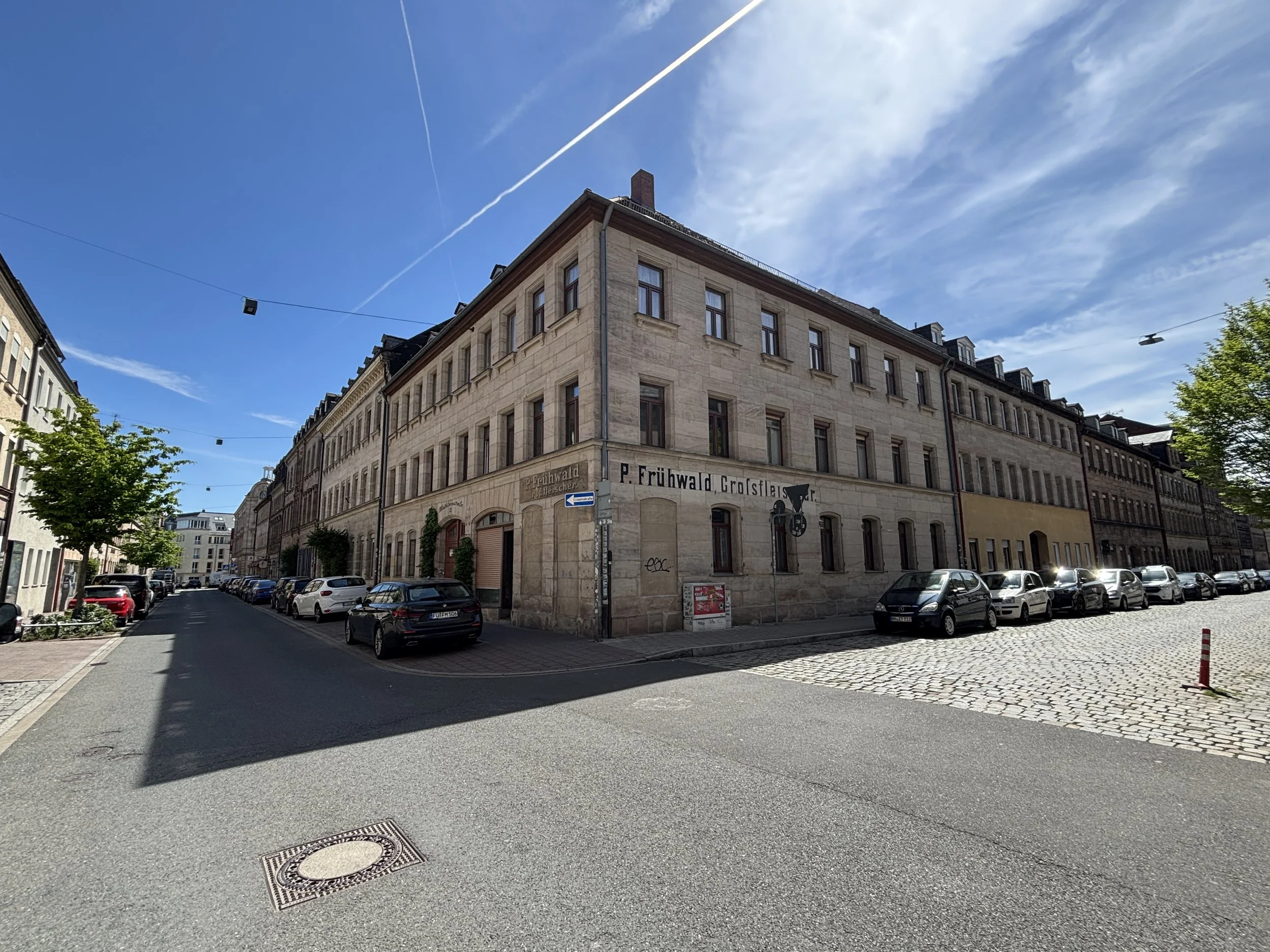
Kissinger was born to a middle class Jewish family at 23, Mathildenstrasse, in central Fürth and his native home still stands at this exact spot in a good state of preservation. A plaque by the door remembers visitors of this historical fact.
Kissinger’s family, however, had to flee Fürth, in 1938, as the environment was turning increasingly dangerous for German Jews. The Kissingers landed in the United States, where young Henry would go on to make a brilliant career, but this is another story that, I am sure, there are many other books and sources better qualified to tell in all detail.
Btw, the area in which Kissinger was born and spend his childhood in, with its broad, orderly avenues and solid residential and commercial housing blocs, is a good example of the modern expansion of the city of Fürth in the 19th C., as the city prospered as an industrial and trading center (in the picture below you can see how the streets of this district mostly look like).
Where to eat in Fürth
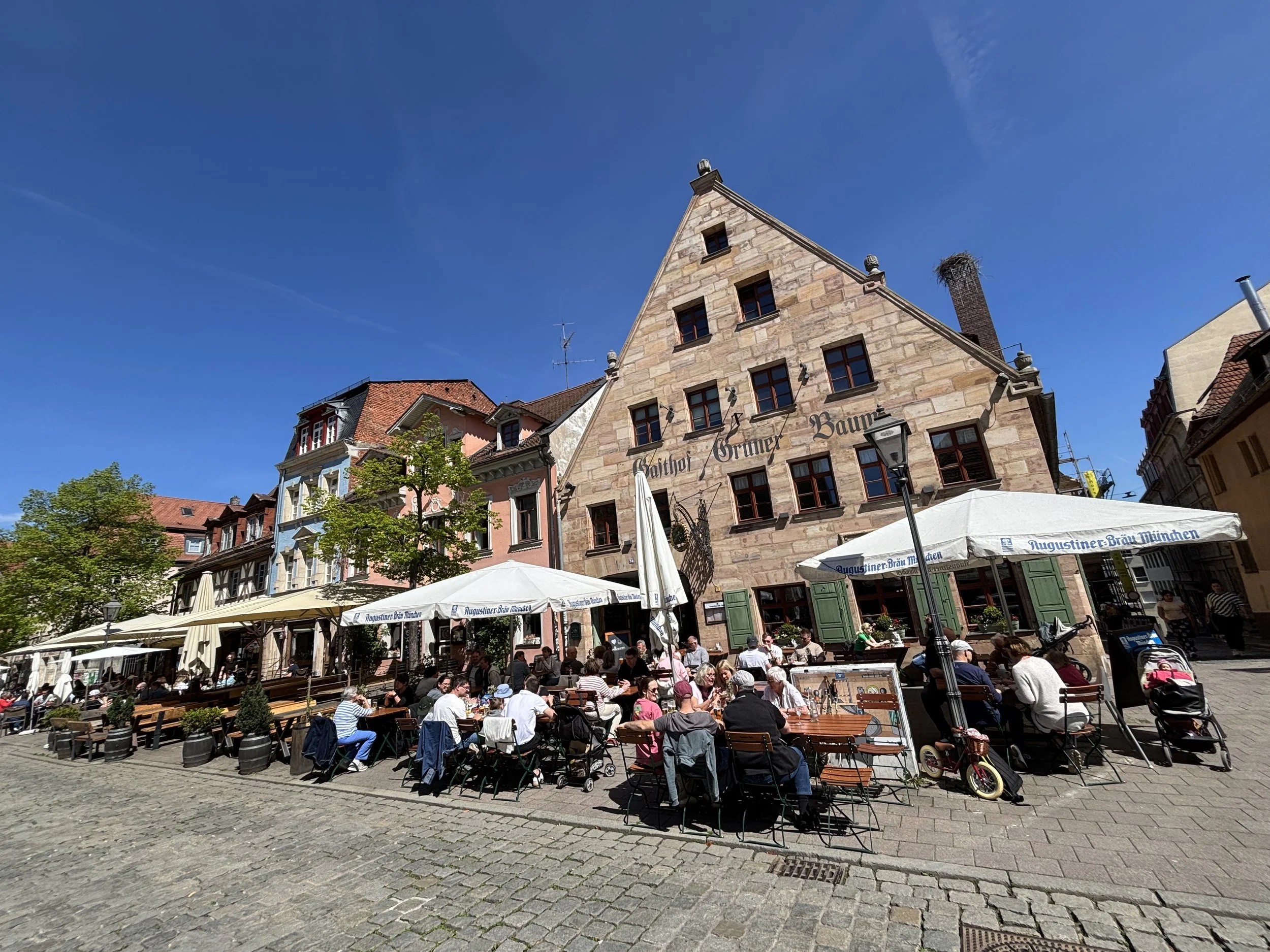
Gasthof Grüner Baum
Gustavstraße 34, 90762 Fürth
This restaurant and guesthouse is located in one of Fürth’s most historical buildings.
While the current building dates largely from the early 19th C., an inn has been documented at this spot since at least 1607. A 2018 renovation uncovered some parts of the old structure, such as a wooden ceiling. Legend has it that the Swedish king Gustav Adolphus may have dined here in 1632, but this is totally unverified!
It has a terrace which is lovely when the weather is nice, as it was the case during my visit.
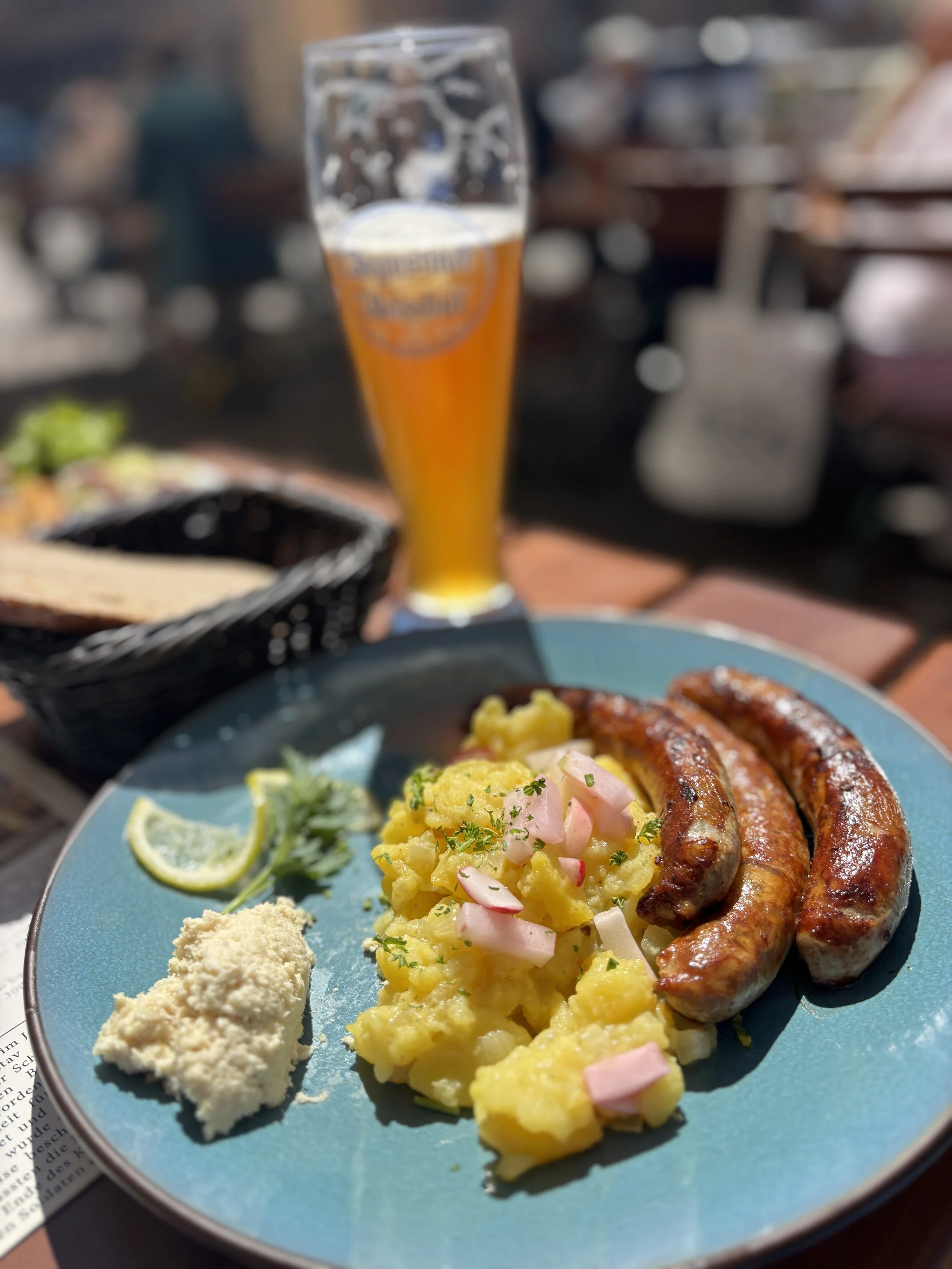
The food was, you guessed it (particularly if you have followed the previous stages of this itinerary)…Franconian cuisine!
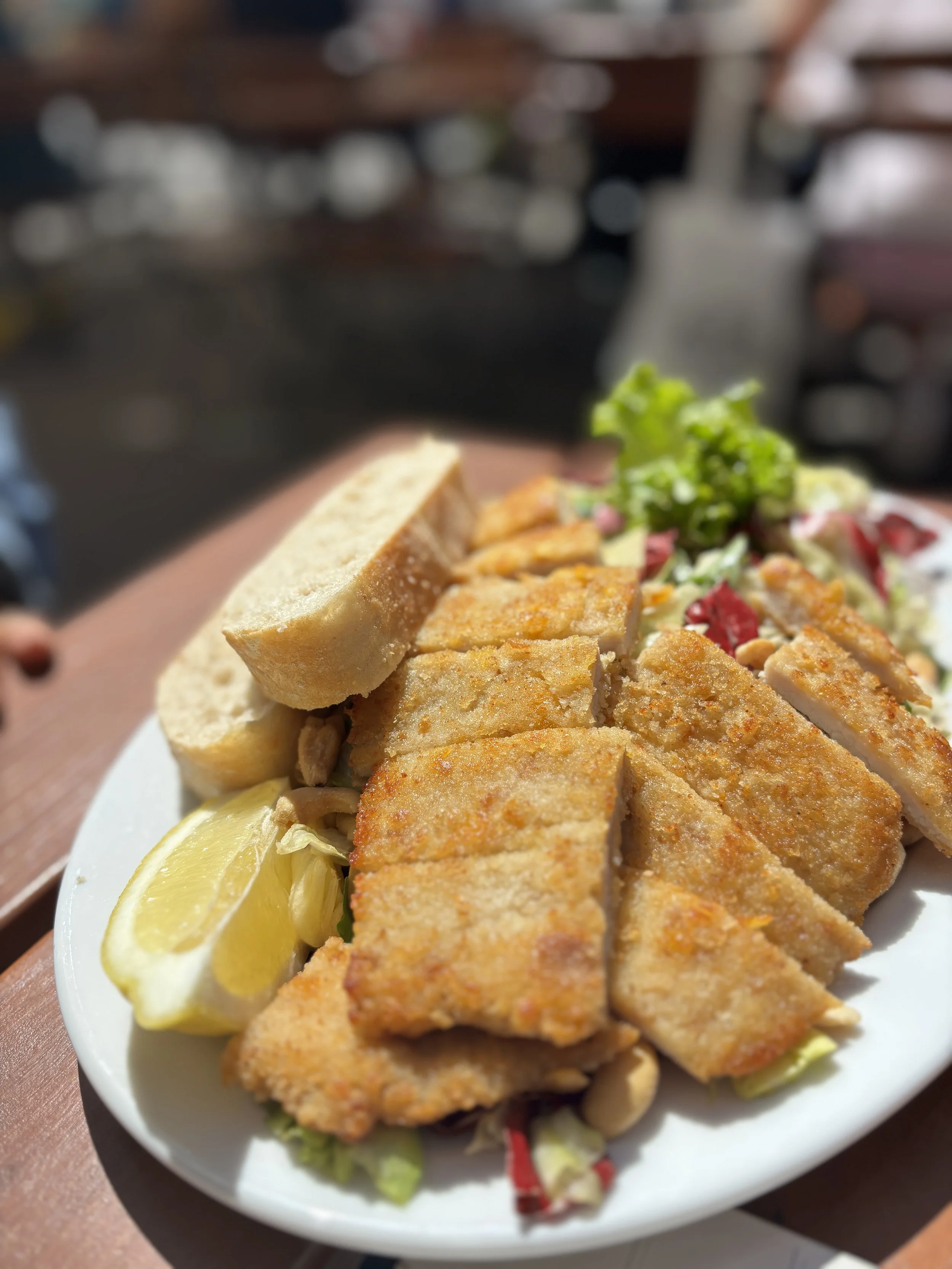
In this case it was the sausages, although those of you that prefer schnitzel, will also be well served here. The dishes were accompanied by a nice potato salad and Bavarian beer.
DÄCHLA Panoramic Terrace
Friedrichstraße 6a, 90762 Fürth
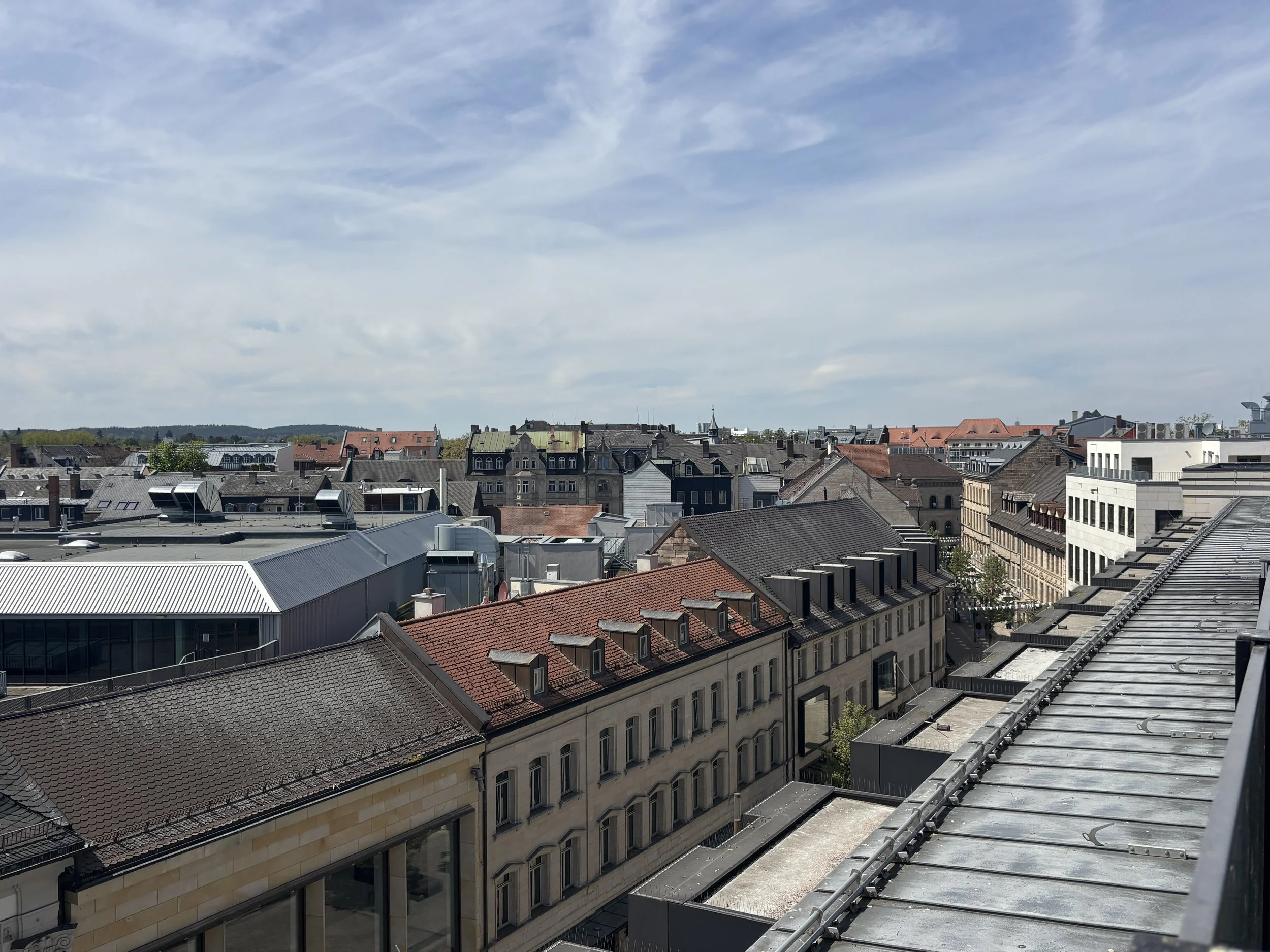
Another place of note in Fürth, particularly if you wish to have a coffee or a drink with some nice views is the rooftop bar at DÄCHLA, which is located at top of a the city’s public library in Dr.-Konrad-Adenauer-Anlage, a public park not far from the main train station.
Dächla, which apparently means “little roof” in Franconian dialect, has a large terrace offering nice views of the city (although not as impressive as the ones from the top of the town hall’s italianate tower).
This modern venue was renovated as recently as 2024. It works mostly as a coffee place during the day, doubling later as a trendy wine bar in the evenings.
Germany’s first railway in Fürth
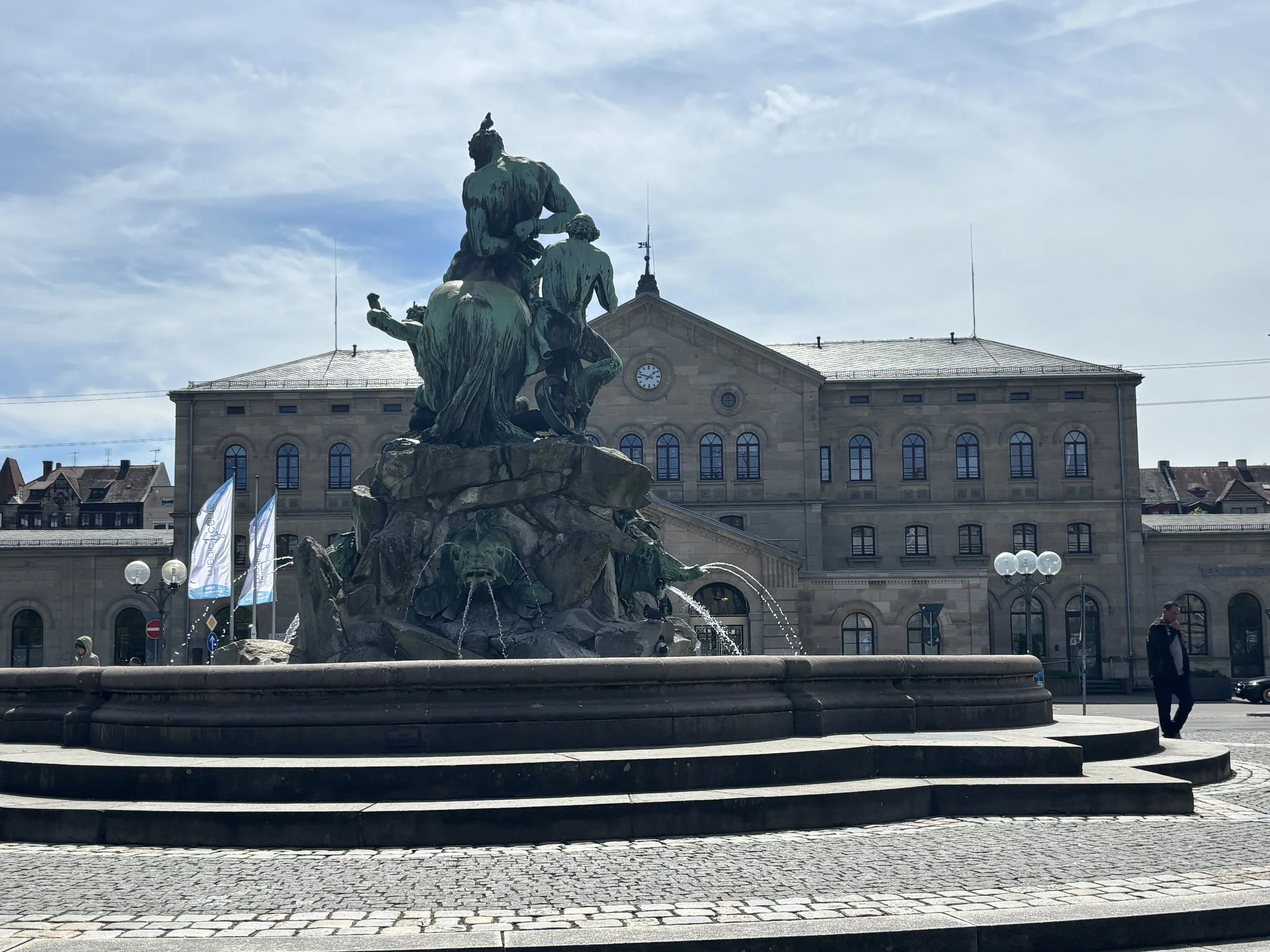
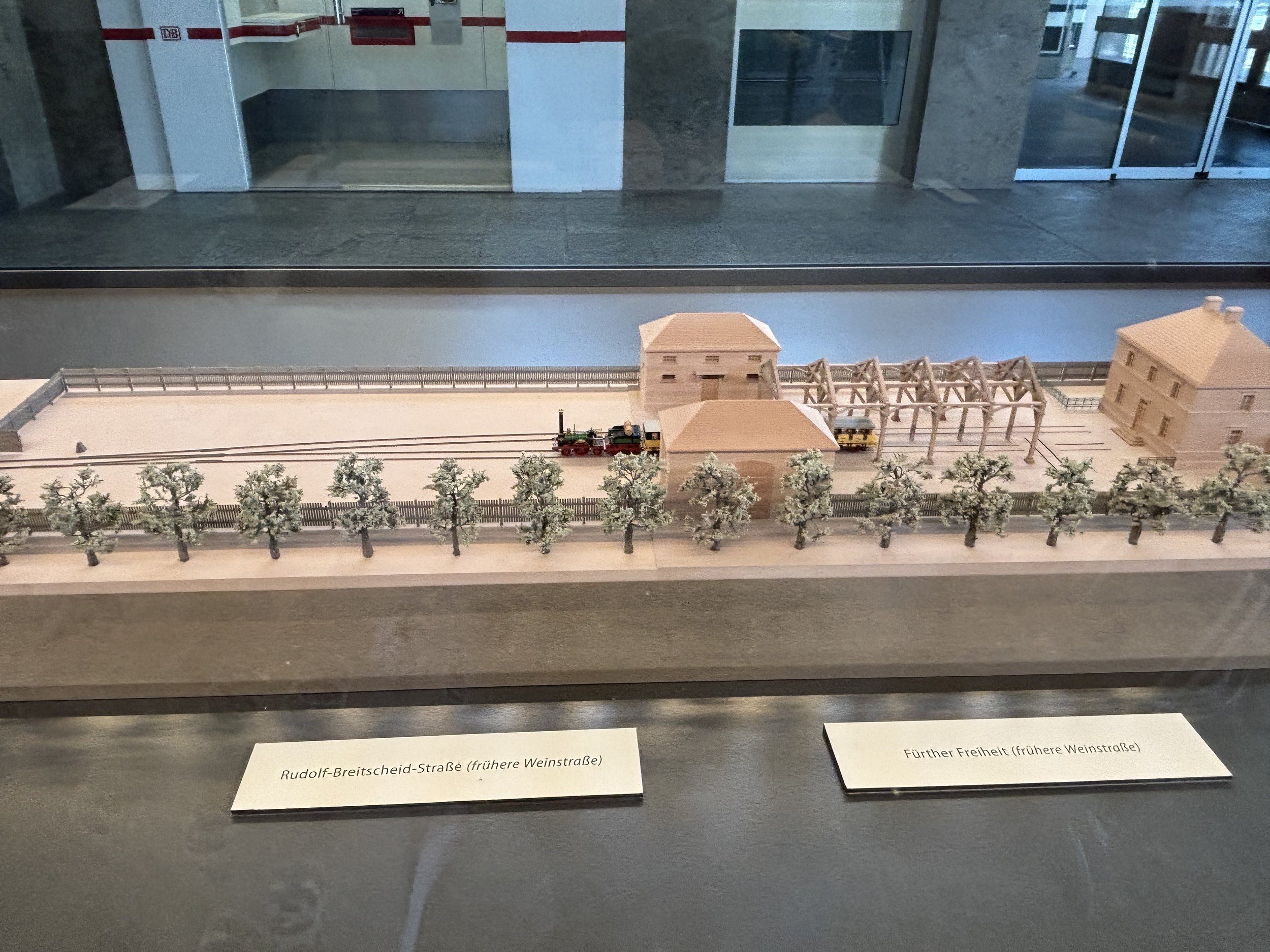
This post about Fürth wouldn't be complete, even more so considering that this visit was part of an all-railway journey, without a mention of Germany's first railway, which connected the city to nearby Nuremberg.
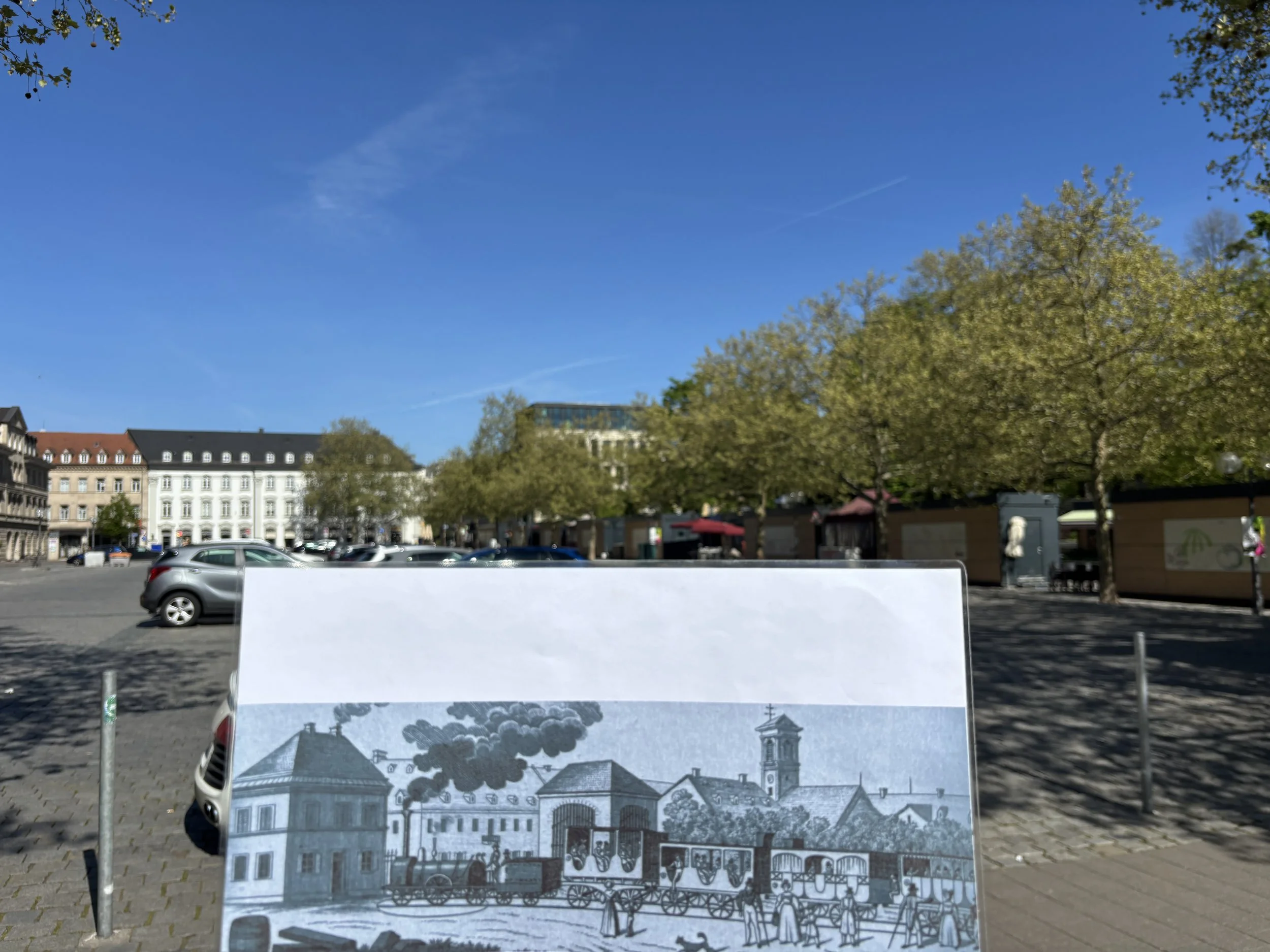
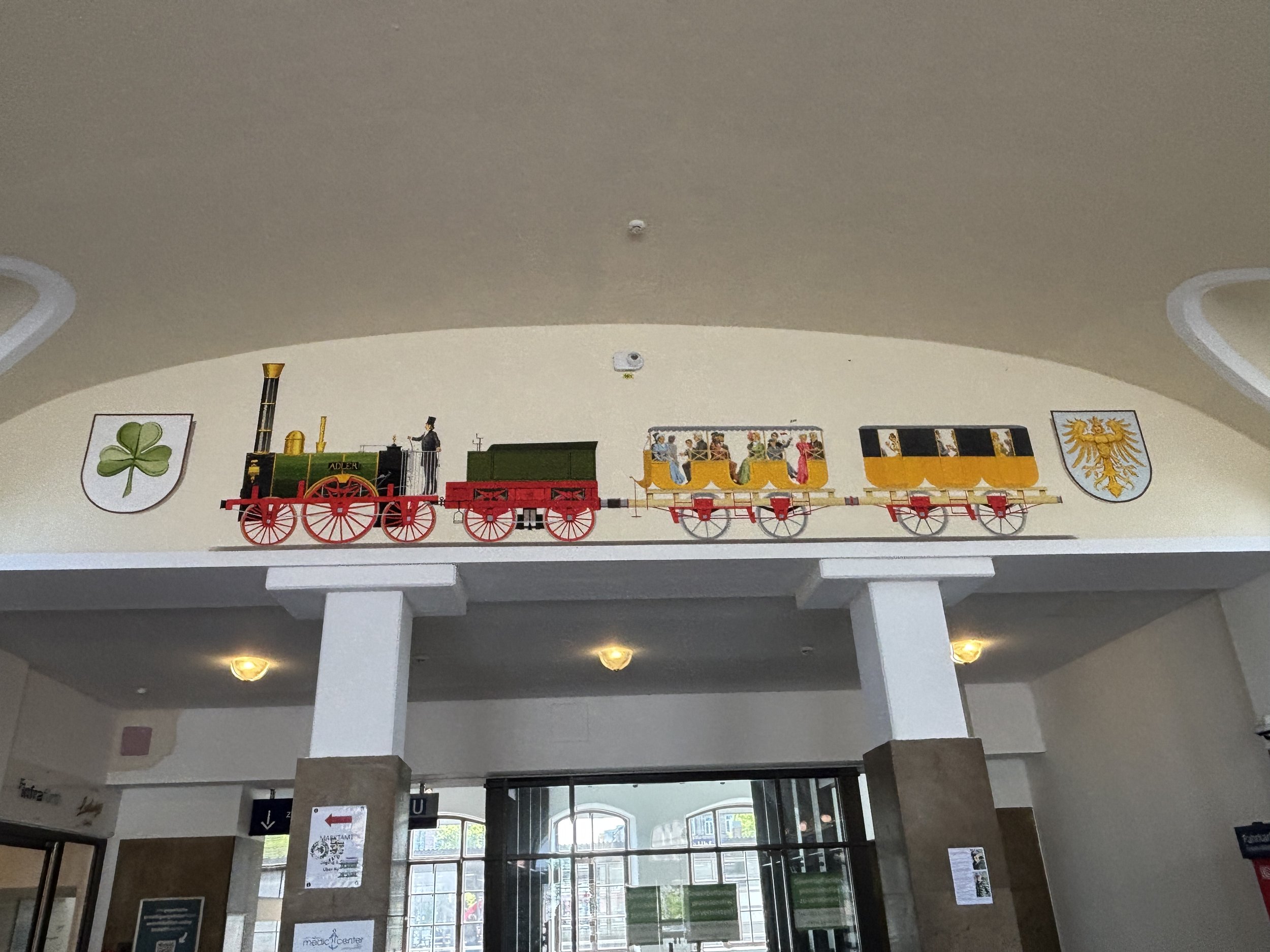
This first German railway line opened in December 1835, with the Adler ("Eagle"), a primitive steam locomotive, making the inaugural six-kilometre run between the two cities.
The train departed not from the present-day railway station but from where today's Fürther Freiheit square is located. The original terminus, known as Ludwig's Station, was demolished in 1938 to make way for a Nazi parade ground. Today this area is a large open square which acts as a venue for several outdoor markets.
The history of Germany’s first railway is also remembered at Fürth’s railway station, where you can find several decor elements and even a scale model that relate to that major historical feat.
If you enjoyed this chronicle from Fürth, stay tuned for the fourth and last installment of the Franconian series, from its major city: Nuremberg.